

The Surge of New Apps: Understanding “Vibe Coding”
The emergence of tools grounded in generative artificial intelligence has significantly impacted mobile application stores, particularly with AI-based development environments that enable the creation of apps without extensive programming knowledge.
A Notable Increase in New Apps
According to data from venture capital firm Andreessen Horowitz (a16z), new app launches in the iOS App Store in the United States saw a 60% increase year-over-year in December, after three years of stagnation. This trend reflects a 24% cumulative year-over-year growth over the last twelve months. This seismic shift in app development can be attributed to a new concept in programming: “vibe coding,” a technique where AI significantly reduces the workload involved in coding.
What Is Vibe Coding?
In 2025, “vibe coding” or “sensation programming” has taken the spotlight. With AI tools, users can now simply describe the application they envision, and the AI generates the necessary code. Platforms like Cursor, Bolt, Google AI Studio, Claude Code, and V0 have democratized app creation, allowing anyone with an idea to develop a prototype without writing any code.
This opens a floodgate of opportunities, with thousands of new developers lacking traditional training jumping into the digital arena. However, this influx brings its own set of challenges.
Echoes of 2008: An Overwhelming Similarity
The current situation mirrors the early days of the iPhone in 2008 when Apple released its SDK and the app count skyrocketed from 500 to over a billion downloads within months. The ecosystem generated hundreds of billions in revenue. Today, however, anyone can create a simple app in just an afternoon, provided they know how to communicate effectively with the AI.
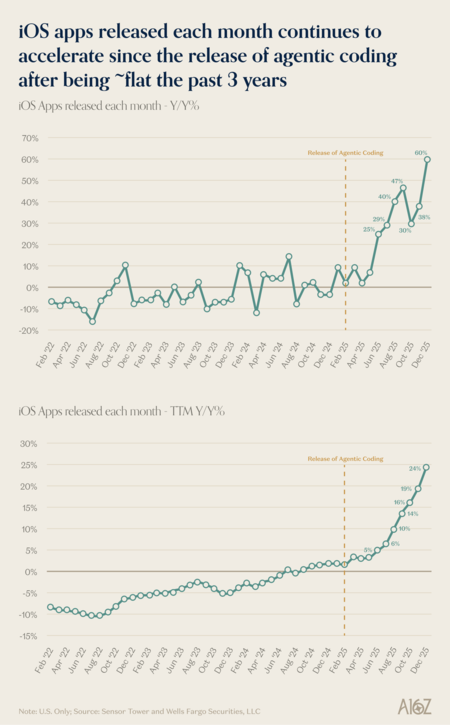
Image: a16z
The Quality Conundrum
While vibe coding might enable the rapid development of new apps, it raises a crucial question: Can complexity be effectively managed? Notably, Miguel Ángel Durán, a well-known software engineer, warns that one cannot produce intricate applications with a mere command to the AI.
As highlighted by colleagues, users like Leo, who claimed to have developed a complete SaaS platform using vibe coding, had to face serious issues shortly thereafter, including public API exposure and a collapsing database due to basic programming oversights.
The Flood of Low-Quality Apps
The ease of app creation has led to an influx of low-quality applications on various stores. Many of these apps do not even qualify as real prototypes, plagued by superficial functionality and technical bugs. This situation is exacerbated if an app includes paywalls.

Looking Ahead: Caution vs. Optimism
While vibe coding clearly empowers individuals to prototype and innovate, experts like Nerea Luis acknowledge its inherent risks, pointing out that without the necessary knowledge, both the user and AI may struggle to complete complex projects. On the optimistic side, Omar Pera, Chief Product Officer of Freepik, points out that vibe coding can significantly enhance the efficiency of top engineers.
Does vibe coding democratize development? Absolutely. However, the challenge emerges when inexperienced developers attempt to scale simple projects into commercially viable applications seeking wide customer adoption.
Conclusion
The evolving landscape of app development, driven by vibe coding, presents both remarkable opportunities and formidable challenges. As with any technological advancement, striking a balance between accessibility and quality will remain crucial for ensuring a thriving app ecosystem.