
Study Overview: The Impact of Ozone Depletion
A recent study led by researcher Shouwei Li from Princeton University has shed light on how the depletion of stratospheric ozone over Antarctica affected Southern Ocean temperatures. Published in Geophysical Research Letters, the study utilized climate simulations to isolate the impacts of this depletion, revealing an intriguing paradox: while the majority of the Earth has experienced warming due to greenhouse gases, a significant marine area near Antarctica has cooled.
Understanding the Cooling Mechanism
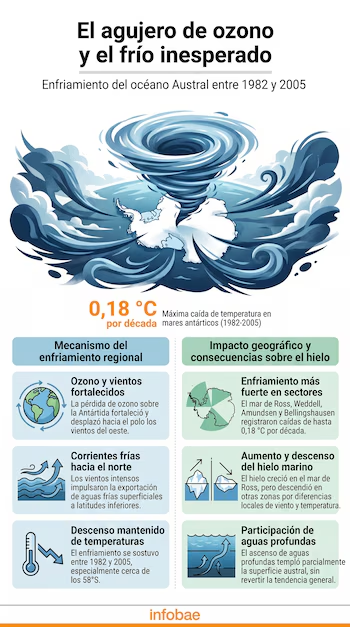
The focus period for this research spanned from 1982 to 2005, coinciding with the peak of ozone hole development. During these years, the depletion of ozone led to the cooling of the lower stratosphere and the strengthening of westerly winds wrapping around Antarctica. The study highlights that these strengthened winds played a key role in transporting cold surface waters toward lower latitudes via a process called Ekman transport, which is influenced by both wind forces and Earth’s rotation.
Magnitude of Cooling
The cooling effect peaked around 58°S, showcasing a steady decreasing trend of about 0.03°C per decade on average. In specific regions, such as the Ross Sea, the Weddell Sea, and the seas of Amundsen and Bellingshausen, temperature drops were even more pronounced, reaching declines of up to 0.18°C per decade in certain areas.
The study identified two primary response phases in the Southern Ocean. The first phase involved rapid cooling driven by horizontal displacement of surface cold water, followed by a slower compensatory rise of warm deep waters. However, this upwelling failed to counterbalance the overall cooling observed throughout the investigation period.
Impact on Sea Ice and Temperature Variability
The impact on sea ice coverage along the Antarctic coastline was inconsistent. For instance, the Ross Sea experienced increased sea ice, while other regions saw declines attributable to localized temperature variations, changes in winds, and other factors like thermal transport and conditions of temperature and salinity.
Additionally, the study found that roughly three-quarters of the observed cooling was directly linked to changes in wind patterns, with the rest due to surface thermal gradient modifications.
Conclusion
This groundbreaking study not only demonstrates how ozone loss has contributed to cooling in the Southern Ocean but also raises essential questions about climate modeling. Historical climate models generally predicted warming in this region, contrasting starkly with satellite observations showing cooling. The new framework used in this research effectively reconstructed the observed cooling signal.
While the study offers critical insights, it underscores that ozone depletion cannot entirely account for all changes and does not negate the broader trend of global warming driven by greenhouse gas emissions. Other factors like anthropogenic aerosols, solar variability, and volcanic eruptions also play a role, albeit on a smaller scale.
The research holds vital implications for understanding the interconnectedness of ozone, winds, ocean dynamics, and sea ice—a complex relationship that is essential for refining future climate projections.