
Your Personal Roman Empire: The World of Tunnel Boring Machines
Each person has their own Roman Empire . These are the few moments each day we dedicate to pondering our passions , whether it’s the vastness of mega-structures or the intricacies of outrageously large tractors. Among the colossal machines that captivate us, tunnel boring machines (TBMs) take center stage. Over the years, TBMs have evolved massively in size and technology, yet their advancement may still be lagging behind the demands of urban development.
After a few years of rapid progress in tunneling technology, the pace of innovation seems to have plateaued. This stagnation raises the question: why?
The Slow Start of Tunnel Boring Machines
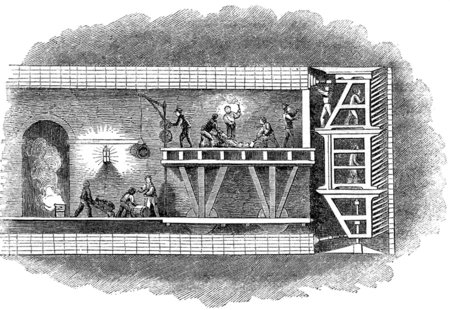
The journey of tunnel boring machines is relatively recent , heavily influenced by advancements in technology. The concept traces back to 1818 when the French engineer Marc Isambard Brunel patented the Tunnel Shield . This groundbreaking design acted as a protective barrier for miners as they excavated underground.
As TBMs advanced, the completed sections were reinforced with bricks , and the shield was moved forward with the help of massive hydraulic jacks. Initially, the operation was still quite labour-intensive , allowing workers to excavate about one meter per day.
Brunel’s shield. Operators work to advance the shield while others install supports from behind.
Automation: A Double-Edged Sword
The evolution of TBMs can be classified into three pivotal phases. The first was the introduction of the protective shield, followed by the mechanization of the tools in the late 19th and early 20th centuries. Engineers experimented with various methods to enhance Brunel’s shield by adding various cutting devices to increase efficiency.
In this era, the advent of pneumatic systems and electric power made the machinery safer. However, the increase in drilling speed was modest; steam engines achieved one to two meters per day, while electric engines could reach two to five meters daily, still slow compared to modern standards.
Advancements in the Mid-20th Century
In the 1950s, American engineer James S. Robbins made significant contributions to TBM technology. He developed a modern tunnel boring machine featuring a rotating head equipped with drag cutters and discs. This design bridged previous technologies and allowed operators to excavate tougher terrains continuously.
This innovation culminated in a system where the head perforated while the shield protected operators , making it safer for workers to place tunnel linings as they advanced. Speeds increased significantly, reaching approximately 200 meters per week , contingent on geological conditions.
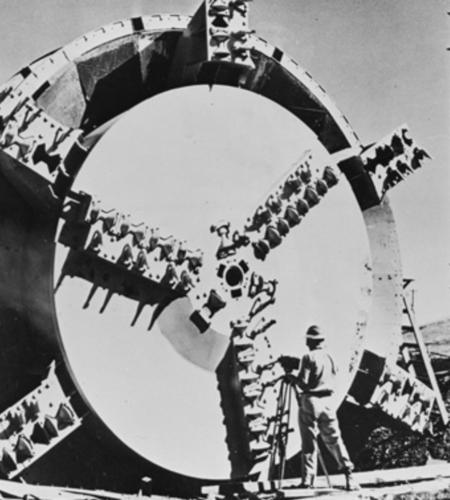
The head of the Oahe tunnel boring machine, a hallmark of modern tunneling technology.
Modern Times and the Stagnant Growth Rate
Fast forward half a century, and while speeds have certainly improved, the pace of progress appears to have stagnated. Although 21st-century machines have become more efficient and automated , the factor limiting speed is not just the machinery; rather, it reflects the complexities of modern urban tunneling.
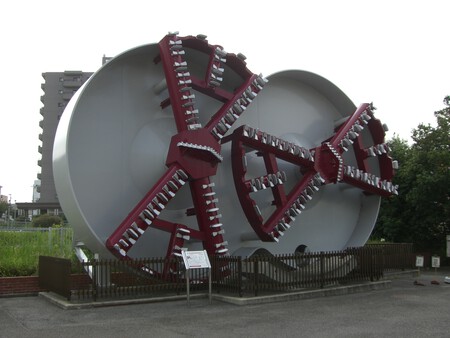
Front view of a modern tunnel boring machine featuring a double-headed design.
The Boring Company: A New Paradigm?
Enter Elon Musk and The Boring Company . With aspirations of dramatically increasing tunneling speeds, their goal is to achieve daily excavation rates exceeding 140 meters , aiming for an astounding 1,600 meters weekly. Their prototype, PRUFROCK , promises to revolutionize tunneling by minimizing downtime for maintenance and segment installation.
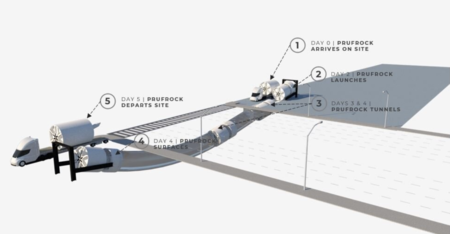
The PRUFROCK machine aims for greater efficiency in tunneling projects.
While the goals seem ambitious, such speeds remain utopian for urban environments where land instability and intricate logistical concerns come into play. Current examples indicate that speeds can average around 15 meters daily in challenging terrains, proving that enhancement is often dictated by geological realities rather than just technological prowess.
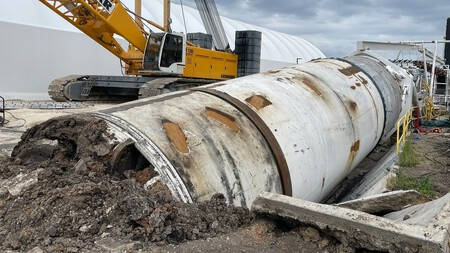
The PRUFROCK in action.
Shifting Focus: Safety Over Speed
While it’s tempting to chase after ever-faster tunneling machines, a paradigm shift towards safety and sustainability might be a more pressing goal. The intricate interplay of geology, debris evacuation logistics, and tunnel safety measures strongly influences how swiftly these machines can operate. Countries like China exemplify this focus by effectively utilizing TBMs while integrating safety protocols with traditional methods like blasting.
Conclusion
In conclusion, the journey of tunnel boring machines reflects the intricate balance between speed , safety , and technological evolution. The stagnation in speed over recent decades raises questions about our priorities in urban infrastructure development. As machines become larger and more capable, there may be a shift towards sustainable, safe construction practices instead of the sheer speed once sought during the early days of tunneling. Ultimately, the future of TBMs may rest in their ability to harmonize rapid progress with the steadfast pillars of safety and sustainability.