

Revolutionizing Parking: The Benefits of Fish Spine Parking
Have you ever pulled into a crowded shopping center and wished for just a little more room to park? If so, you are not alone. Many drivers get frustrated with those who occupy two parking spaces or, worse, the ever-increasing size of modern vehicles compared to the static dimensions of parking spots. But can parking spaces be designed more efficiently? A striking solution has surfaced on various platforms, particularly Reddit: the German fish spine parking system , which claims to make parking 60% more space-efficient. But is this claim backed by research?
The architectural marvel known as fish spine parking —also referred to as herringbone parking , angled parking , or geometric parking —is gaining attention for maximizing car capacity in parking areas. Though its efficiencies are often praised, opinions vary on the extent of its advantages.
If you look at the layout referenced in Reddit discussions, it resembles the intricate design of fish spines. In this type of parking, vehicles are angled at 30º, 45º, or 60º from the main circulation lane, creating rows that are staggered and can coexist together effectively.
The advantages of fish spine parking are considerable. First, the angle allows drivers to maneuver their vehicles into parking spots with far less effort compared to traditional 90º perpendicular parking . This makes it easier to park while also maintaining a safe distance from neighboring vehicles. Moreover, studies have shown that angled parking reduces the number of maneuvers required, thus optimizing space much more effectively compared to parallel parking.
Another key benefit is safety . Since it resembles a one-way street design, drivers can anticipate the flow of incoming traffic, which adds an extra layer of security during parking. Although reversing may be necessary, the low speeds typical in parking lots generally do not pose a significant risk.
The research surrounding the efficiency of these parking designs can seem contradictory. Some studies suggest that a 60º angle is optimal for maximizing capacity, allowing for 5.2 cars in a 100 m² area, while others indicate that 90º spaces may accommodate a similar number. The true effectiveness comes down to line distribution and how the spaces are organized.
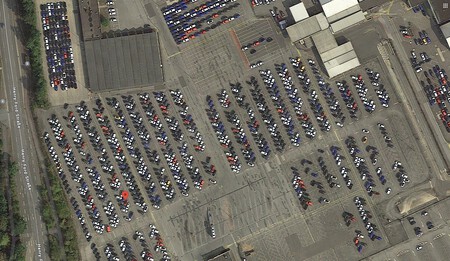
In one illuminating study by David Percy , an academic from the University of Salford, the calculations revealed that if a parking lot accommodates 500 cars at a 90º angle , it could fit 619 cars at a 45º angle —an impressive efficiency jump of 23.8% . While less than the 60% often claimed, it still demonstrates a significant advancement.
The size of the parking lot plays a crucial role in determining the efficiency of the fish spine system. Large parking facilities benefit much more from angled parking, as they require less maneuvering room, allowing for narrower traffic lanes . Conversely, smaller parking areas might experience a disproportionate amount of wasted space on the edges.
In denser parking scenarios, research shows that 80 cars can occupy 7% less space with angled parking compared to traditional setups, emphasizing the importance of layout efficiency. Essentially, larger parking structures significantly benefit from adopting a fish spine configuration.
While proponents of fish spine parking tout its benefits, practical application may show a more nuanced picture. For example, a comparison might reveal it is more manageable to park but in crowded lots, maximizing space holds precedence over ease of access.
Curiously enough, finding fish spine parking layouts remains a challenge, even on platforms like Google Maps. While they are predominantly found in Germany and other countries, their practical uses and layouts differ widely, leading to varied designs based on needs and local structures.
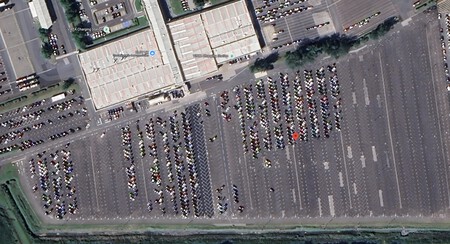
Across various locations, including electric vehicle factories like BMW’s in Germany, conventional parking still exists alongside fish spine models, demonstrating the adaptability of parking solutions to their environments. However, even outside of Germany, variations of fish spine parking designs can be found, such as in Ciudad Real , Spain, proving that flexibility in parking configurations is possible and practical.

In conclusion, while fish spine parking presents an innovative solution to urban parking challenges, its efficacy hinges on specific parameters, including the available space. The variety in parking models demonstrates that while one solution might excel in a particular scenario, different environments may require tailored approaches to meet their unique needs.
Images | Google Maps, Unsplash