

The Silent Shadows of Power: Understanding China’s Role in the Cold War Nuclear Race
Discussing the Cold War often evokes images filled with espionage , secret military bases , and advanced weaponry poised for a potential armed conflict. The looming specter of an atomic arsenal creates a backdrop of constant fear regarding nuclear apocalypse. While the United States and the Soviet Union often take center stage, we must not overlook China , a crucial player in this global tension during the Cold War era. Understanding China’s entry into the nuclear arms race reveals a compelling narrative that extends beyond conventional paradigms of power.
At the heart of this narrative is the Nuclear Military Plant 816 , the world’s largest underground nuclear facility, symbolizing China’s ambitions in the nuclear domain.
Bad Blood with the USSR
To grasp the dynamics between China and the Soviet Union, we must acknowledge the Sino-Soviet Split . The rivalry for supremacy in the communist world escalated into a complex conflict where in 1969 , the Soviet Union even considered nuclear bombardment of China, targeting major cities like Beijing.
The U.S. made a strategic intervention by normalizing relations with China, which resulted in a shift in the balance of power. Nevertheless, with mounting concerns over possible Soviet aggression, China embarked on building the Nuclear Military Plant 816 as a critical initiative to develop its nuclear capabilities .
A Strategic Undertaking
Under the leadership of then-Prime Minister Zhou Enlai , China initiated the project in 1966 , creating an underground military base in the Chongqing region. This installation was not merely a bunker; it aimed to serve as a crucial facility for producing plutonium —the key element in crafting nuclear warheads—independent of Soviet support.
The scale of construction was monumental, involving over 60,000 soldiers from the People’s Liberation Army . The design aimed to withstand missile attacks and even earthquakes measuring up to 8 on the Richter scale. The facility’s natural defenses were reinforced by the granite formations of Jinzi Mountain , presenting a formidable barrier against potential threats.
A Colossal Secret
One of the most striking features of the Nuclear Military Plant 816 is its sheer size. Spanning over 104,000 square meters , it comprises the largest artificially excavated tunnel system in the world. With 130 tunnels stretching over 20 kilometers , it’s comparable to a 25-story building, showcasing the incredible engineering feats of the time.
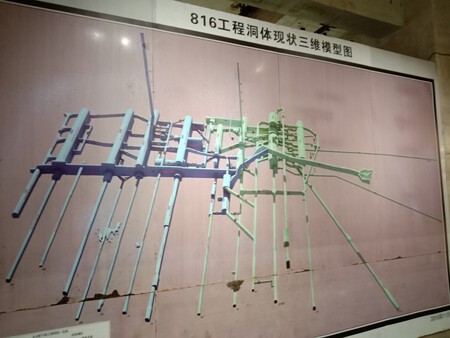
That is … it’s huge
However, the secretive nature of this project was alarming. Workers were often oblivious to the actual purpose of their labor, as severe opacity surrounded the project. Official records cite 76 fatalities during construction over a span of 17 years , though some sources suggest the casualty numbers could be significantly higher.
Technological Advances and Halting Progress
China’s nuclear program made significant advances during this time, with its first public nuclear test in 1964 . Despite the earnest efforts invested into the construction of Plant 816, it ultimately remained non-operational, particularly due to shifts in international relations and decreasing Cold War tensions. By 1984 , the facility’s purpose was officially classified as obsolete.
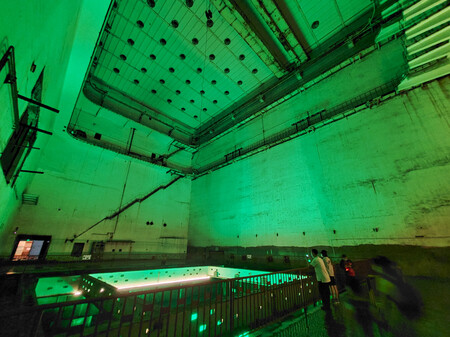
The reactor room
In 2002, it was revealed that remnants of the Plant 816 had been repurposed into a fertilizer factory , shedding light on a nearly forgotten chapter of China’s military history.
Embracing the Past: A Touristic Attraction
<pRecognizing the unique historical significance of the site, Chinese authorities opened part of this vast underground facility to the public in 2010. This decision allowed visitors to glimpse the past—an era where the fears of global nuclear conflict loomed large. Photographic evidence can now be appreciated, documenting the stark reality of a base designed for nuclear missile production over 60 years ago.
As a museum, the site also serves as a memorial to the lives lost during the construction of the complex—both recognized and unacknowledged, addressing the human sacrifices behind the scenes of Cold War armament.
Images Source: Various contributors on Wikimedia Commons.