
The Alarming Rise of Cocaine Production: A Global Perspective
In the complex realm of global drug consumption, recent statistics reveal a concerning trend. If you were to gather one hundred adults, it’s estimated that six of them have used drugs recently. This statistic is a direct reflection of the latest report from the United Nations regarding narcotics, indicating that while cocaine may not be the most widely consumed substance, its global market is reaching unprecedented heights. In fact, the production of cocaine has surged by a staggering 34% within just one year.
The spotlight, however, predominantly shines on one specific country: Colombia. The United Nations released this alarming data during the celebration of the International Day Against Drug Abuse and Illicit Trafficking on June 26, highlighting that approximately 316 million people used drugs in 2023. This figure, which represents 6% of the adult population globally aged between 15 and 65, reflects an increase from barely 5% just a decade ago.
Cannabis: The Predominant Drug
The UN’s findings also indicate that cannabis maintains its position as the most popular drug, with around 244 million users globally. Following cannabis are opioids (61 million users), amphetamines (approximately 30.7 million), and finally, cocaine, which had an estimated 25 million users in 2023. Although cocaine is not the most consumed drug, its market dynamics demand special attention due to its rapid growth.
The UN Office on Drugs and Crime (UNODC) warns that "production, seizures, and consumption reached new maximums in 2023." Their statistics reveal that illegal cocaine production in 2023 soared to an astonishing 3,708 tons, which is nearly a 34% increase compared to the previous year. This rise is predominantly fueled by a growing consumer demand; for instance, cocaine use has increased from 17 million users in 2013 to 25 million in 2023.
New Markets: Asia and Africa
A crucial aspect of this growing issue is the expansion of drug trafficking networks. Traffickers are now targeting new markets in Asia and Africa, marking a significant shift in the dynamics of the cocaine trade. Únderstanding the new routes and methods adopted by these traffickers is vital, especially as violence and competition in the illegal cocaine market are no longer limited to Latin America. Criminal organizations from the Western Balkans are increasingly influencing the market, expanding operations into Western Europe.
This evolving landscape has also led to an increase in drug seizures. Between 2019 and 2023, seizures rose by 68%, reaching a record high of 2,275 tons.
Colombia: The Epicenter of Cocaine Production
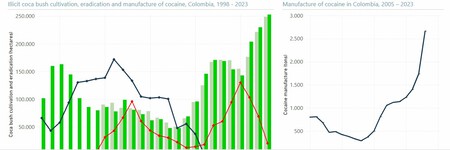
The question arises: what is driving the increase in cocaine production, and where are these drugs being cultivated? The answer is predominantly found in Colombia, which has seen a 10% rise in coca bush cultivation in 2023, now amounting to around 253,000 hectares with an estimated potential production of 2,664 metric tons of cocaine. This represents a 53% increase compared to 2022.
Interestingly, coca cultivation is not confined to particular regions. Unlike the previous years when production was mainly concentrated in Putumayo, the cultivation in 2023 strengthened across 16 out of 19 coca-producing departments, significantly broadening the areas involved in cocaine cultivation.
The UNODC points out that Colombia accounts for 67% of the world’s coca crop, which leads to an explosive increase in the global cocaine market. This data emphasizes the dire need for comprehensive strategies to tackle the proliferation of drug production in Colombia.
Challenges in Drug Policy
While production continues to rise, law enforcement efforts remain critical in combating drug trafficking. National authorities seized 883 tons of cocaine in 2024 alone, with 403 tons already confiscated in 2025. The fight against drug trafficking has become a focal point of national political debate in Colombia, where various viewpoints advocate for different approaches to curb this growing crisis.
Additionally, the cocaine market has experienced significant price fluctuations. Reports indicate that the price per kilogram has dramatically dropped from over 30,000 euros to about 15,000 euros. These changes can be attributed to a variety of factors, including the Colombian government’s decision to halt the use of glyphosate—a known herbicide used to eradicate coca crops—due to its harmful effects.
In conclusion, the increasing statistics surrounding cocaine production and consumption pose daunting challenges for governments, health organizations, and communities worldwide. Understanding the dynamics of drug trafficking, especially concerning Colombia’s pivotal role, is essential for developing proactive strategies to combat drug abuse and trafficking effectively. Urgent collective efforts are needed to address this growing crisis, promote education, and implement sustainable policies that can curb both the production and consumption of cocaine.