
Israeli Army Launches Large-Scale Attacks in Tehran
Overview of Recent Developments
On April 1, 2026, the situation in the Middle East escalated dramatically as the Israeli army executed a significant wave of attacks on targets in Tehran. This military initiative follows a series of missile strikes by Iran on various locations, including Kuwait and Saudi Arabia. The ongoing conflict has drawn in major players such as the United States, with President Donald Trump announcing plans for the U.S. troop withdrawal from Iran to take place within two to three weeks.
U.S. Involvement and Intentions
In light of the conflict, President Trump is expected to deliver an “important update” on the war in Iran on April 1 at 9:00 p.m. EST. He emphasized from the Oval Office that the American military presence in the region would soon be reduced, stating, “We are finishing the job.” His remarks align with Israeli Prime Minister Benjamin Netanyahu’s commitment to continue operations against what he labeled as the “regime of terror” in Iran until its power structure is dismantled.
Iran’s Counteraction
Iran’s response to the Israeli airstrikes has been aggressive. President Masud Pezeshkian indicated that Iran is willing to seek peace but requires guarantees to prevent future hostilities. In retaliation, Tehran launched missile attacks that targeted multiple countries in the region, suggesting a widening of the conflict that now involves Iraq, the United Arab Emirates, and Bahrain.
Impact of Attacks on Civilians
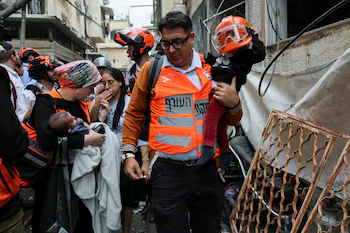
The strikes have resulted in civilian casualties and injuries. An 11-year-old Israeli child was reported to be in serious condition due to a missile strike attributed to Iranian forces, with additional reports of 12 other injuries across central and northern Israel. Emergency services have been deployed to assist affected areas, amid heightened missile alerts.
International Reactions
The situation has prompted international concern and scrutiny. The United States has stated that it will no longer assume direct responsibility for the security of the Strait of Hormuz, a crucial area for global oil transportation. Secretary of State Marco Rubio called for a reassessment of the U.S. relationship with NATO in light of the current operations in Iran, questioning the alliance’s value amidst European restrictions on military base usage.
Ongoing Military Operations
The Israel Defense Forces (IDF) reported conducting over 10,000 operations in Iran, with significant recent activity targeting the Iranian military infrastructure. Israeli strikes have aimed at various strategic locations, including military headquarters and facilities linked to missile development.
Conclusion
The rapid developments in the Israeli-Iranian conflict underline a complex geopolitical landscape characterized by military strategies and diplomatic tensions. With both sides showing no signs of de-escalation, the coming weeks are crucial in determining the trajectory of the conflict and its implications for regional stability. As the international community watches closely, the actions taken by both Israel and Iran will have lasting repercussions.