
The Essential Role of Submarine Cables in Global Connectivity
We often take for granted the instant access we have to information and digital services. However, the backbone of this connectivity lies beneath the ocean in the form of submarine cables. According to reports, 99% of global internet traffic relies on these underwater cables, making them an indispensable element of our digital infrastructure. While we seldom see them, submarine cables play a critical role in the functioning of our world today. They have not only been instrumental in global communication but have also been at the heart of several international conflicts.
Among the notable efforts to expand and modernize these networks are projects like the one connecting Santander, Spain, to the United States. This vital infrastructure is deployed using specialized ships, one of which is the Lisa Monna.
An Introduction to the Lisa Monna
The Lisa Monna is a state-of-the-art cable-laying vessel constructed in Romania in 2022, under the commission of Prysmian Group, a prominent player in the cable industry. With a remarkable investment of €250 million, it officially commenced operations this year. The primary mission of the Lisa Monna is to lay and bury submarine cables effectively, reaching depths of up to 3,000 meters.
Specifications That Stand Out
At 171 meters long and 34 meters wide, the Lisa Monna is currently one of the largest cable-laying vessels in the world, joined only by its sister ship, the Leonardo da Vinci. Although a larger ship is currently being assembled in China, Lisa Monna provides unrivaled capabilities in the market until that ship becomes operational, anticipated for 2026.
Onboard, the vessel can carry two cable coils, one weighing 7,000 tons and the other 10,000 tons. It has the capacity to accommodate 120 crew members, allowing for long missions of up to 90 days at a maximum speed of 16 knots.
The Art of Laying and Burying Cables
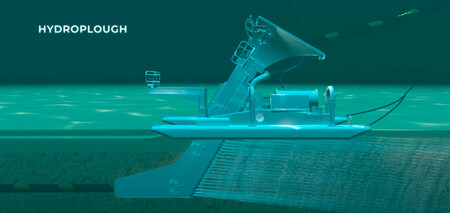
Historically, submarine cables were laid without any protective measures, leading to significant vulnerabilities and damage. However, the Lisa Monna utilizes advanced methods for laying and burying these cables. The ship employs a technique that involves a Hydroplow to create a trench on the seabed where the cable can be securely placed. This trench can range from 2 to 3 meters deep, offering the cables necessary protection. The Hydroplow effectively drags the necessary equipment, depositing both the cable and soil into the trench automatically.
In scenarios where the seabed proves challenging, the Lisa Monna has multiple excavating robots ready to spring into action. This additional equipment ensures that the ship can operate efficiently across varying seabed conditions.
Precision Positioning for Effective Deployment
Equipped with a DP3 dynamic positioning system, the Lisa Monna ensures remarkable accuracy during cable deployment. This system is designed to counteract mechanical, electrical, or software failures to maintain its position, which is crucial for laying cables to centimeter precision. To enhance maneuverability, the ship also features an eight-point mooring system.
The Prysmian Fleet
The Lisa Monna is part of a two-ship fleet owned by the Prysmian Group. Its sister ship, the Leonardo da Vinci, complements its operations as global demand for submarine cables continues to rise. In addition, another vessel is currently under construction, set to join the fleet by 2027.
In an exciting development, the Lisa Monna transported its first cable earlier this year and is actively deploying this cable along the East Coast of the United States for a groundbreaking offshore wind farm project.
Images | Prysmian
Submarine cables may be out of sight, but their impact is felt every day through our seamless digital experiences. Without advancements in technology and specialized vessels like the Lisa Monna, our connected world would face immense challenges. As the industry continues to grow, the importance of these underwater lifelines will only become clearer. The future remains both promising and essential, given the increasing reliance on digital communication and the need for robust infrastructure to support it.