
The Milky Way: A New Perspective on Size
Imagine never stepping outside your house. Would you be better equipped to sketch your own building or the one across the street? The answer is clear. Observing the neighboring structure allows us to see details that remain hidden in our own home. The same principle applies to galaxies. Over the years, gathering data from adjacent galaxies has proven easier than studying our own Milky Way, leaving its structure and size shrouded in uncertainty. However, thanks to the ESA Gaia mission, we now possess an incredibly detailed map of our galaxy, revealing insights about its composition, including the surprising discovery that it has four arms rather than the previously thought two.
Size Matters: The Milky Way Is 10% Bigger
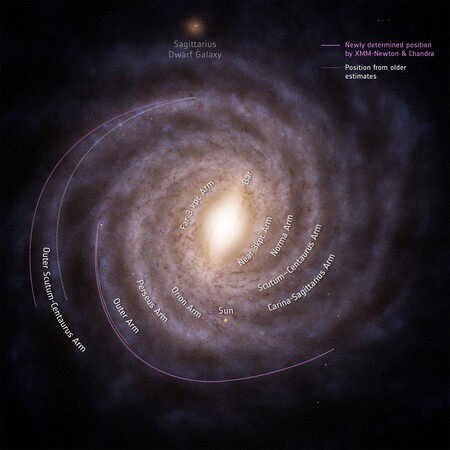
Navigating unexplored territories, researchers from NASA and ESA have made a groundbreaking discovery: the Milky Way is 10% larger than previously estimated. Using two powerful X-ray observatories—NASA’s Chandra and ESA’s XMM-Newton—they analyzed X-rays emitted by gamma-ray bursts from distant galaxies. The findings indicate that the distance between the galaxy’s outermost arms extends beyond previous calculations.
Understanding the Role of X-rays
Gamma-ray bursts are recognized as the most explosive phenomena in the universe. Following these immense explosions, emissions are released across the electromagnetic spectrum, including X-rays. These emissions can be captured by observatories like ESA and NASA’s, allowing scientists to gain critical data about neighboring galaxies. Some of the X-rays reach Earth and the Milky Way, where they can help us determine our galaxy’s dimensions.
The X-rays that reach Earth can be categorized into two types: those that travel directly and those that are dispersed by stellar dust clouds. Observing these two types is essential for decoding the Milky Way’s size.
The Significance of Angles
Initially, the direct X-rays arrive at the observatories, followed by the dispersed rays. The scattered rays, coming from various angles, create a concentric circle pattern in the detectors. The central core contains the direct rays, while the surrounding circles represent the scattered emissions. Each concentric circle corresponds to X-rays scattered from the same distance, providing insight into the galaxy’s architecture.
This innovative approach has allowed scientists to accurately measure the distance between the Milky Way’s different arms. For the first time, researchers have employed data from three gamma-ray bursts spanning the Perseus and Scutum-Centaurus arms, leading to an updated estimation of our galaxy’s size, which is now confirmed to be larger than previously thought.
A Technological Triumph
Both Chandra and XMM-Newton were launched in 1999, yet they continue to provide invaluable data regarding the Milky Way. Some may consider them outdated, but the enduring relevance of their findings demonstrates the importance of utilizing existing technologies effectively. Just as measuring our house’s shadow helps clarify its dimensions, analyzing data from neighboring galaxies can reveal profound insights about our own.
In summary, the recent findings not only expand our understanding of the Milky Way but also highlight the innovative capabilities of modern astronomy. This revelation invites a fresh appreciation for the mysteries still waiting to be uncovered in our universe.
Conclusion
The Milky Way’s newfound size—a staggering 10% larger than estimated—has far-reaching implications for our understanding of the cosmos. By leveraging advanced technologies and collaborative efforts between NASA and ESA, we can continue to chart the intricacies of our galaxy and beyond.
Images | Magnificent | ESA/Gaia/DPAC, Stefan Payne-Wardenaar, ESA/XMM-Newton and NASA/Chandra