
In the 1980s , China’s road network was in its infancy. At that time, the nation lacked highways and relied primarily on its extensive rail system for transport. However, the mid-1980s marked the beginning of a significant transition, symbolized by the construction of the Shanghai-Jiading Highway . By 2005, China’s Minister of Transportation, He pledged to construct 85,000 kilometers of roadways within the next 30 years. Among these developments lies a remarkable segment—one of the most imposing highways in the world.
The “Staircase to Heaven” from China
The Yaxi Expressway embodies the concept of “all roads lead to Rome” in China, particularly in relation to Beijing . The highway connects the capital to other critical commercial hubs, ensuring efficient transport for a significant volume of goods across the nation. A part of the massive Beijing-Kunming Highway —which stretches 2,700 kilometers—the Yaxi Expressway features a segment frequently dubbed the “Staircase to Heaven.”
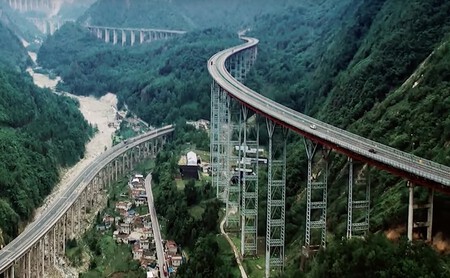
</div>This 240-kilometer stretch connects the cities of Xichang and Ya’an , constructed between 2007 and 2012 at a cost of approximately 3.3 billion dollars . To give a comparative perspective, the average cost of constructing a kilometer of highway in Spain is around 8.8 million euros . The expense incurred for the Yaxi Expressway is justified considering its unique characteristics and the complex terrain it traverses.
<img alt="Tourist Attraction at the Yaxi Expressway" width="375" height="142" src="https://i.blogs.es/08f033/captura-de-pantalla-2024-10-19-a-las-14.38.08/375_142.jpeg"/>The Yaxi Expressway is remarkable not only for its length but also for its engineering feats. It is characterized by 270 viaducts that navigate steep inclines and 25 tunnels , totaling 41 kilometers underground. Among these tunnels is the Nibashan Tunnel , which holds the title of being the deepest in China, descending approximately 1,650 meters over a span of 10 kilometers. This construction significantly reduces travel time from hours to just ten minutes around the mountain, showcasing the expressway’s efficiency.
However, the expressway is dubbed the “staircase to heaven” for its ascension to an altitude of over 2,430 meters . Specifically, one section rises at a rate of 7.5 meters for every kilometer traveled , culminating in 51 kilometers of continuous ascent with an average slope of 3% .
This rigorous ascent, along with the full route, can be appreciated in an informative video:
The surrounding mountains add to the expressway’s spectacular views. The video exhibits intriguing spiral-shaped tunnels successfully designed to minimize environmental impact, integrating into the complex topography:
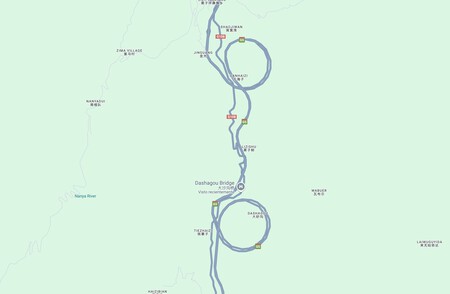
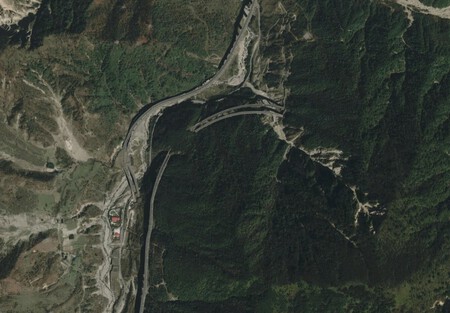
</div>Two surrounding mountains are avoided entirely by employing this innovative tunnel design, which has proven advantageous in complex environments. The images displaying the relief highlight sections of the “snail” tunnel structures emerging from the mountains:
</div>The significance of the Yaxi Expressway extends beyond its extraordinary technical features. This highway is pivotal in connecting mountainous regions that were previously isolated, facilitating local economic development and easing the integration of ethnic minorities, such as the Han, Hui , and Tibetans .
Driving on this road can prove challenging due to fluctuating weather conditions linked to altitude changes, sharp curves, and steep slopes, making it both a thrilling and difficult journey.
<img alt="Innovative Road Construction Methods" width="375" height="142" src="https://i.blogs.es/fc3b9a/640-copia/375_142.jpeg"/>Moreover, the “Staircase to Heaven” has evolved into a noteworthy tourist attraction , illustrating China’s robust civil engineering capabilities. The country’s remarkable advancements in infrastructure within just a few decades are evident, especially when it comes to building complex bridges and highways.
Overall, the Yaxi Expressway serves as a testament to China’s commitment to improving connectivity and infrastructure. By bridging remote and mountainous areas, it not only aids in economic growth but also opens doors for cultural exchange among diverse communities. The feats accomplished in civil engineering here promise to inspire future infrastructure developments worldwide.