
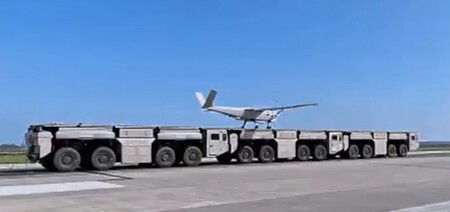
China is exploring an unusual idea even at a time when drones have become a protagonist in almost every military conversation: taking some of the logic of an aviation catapult from the aircraft carrier and bringing it to trucks and containers. We are not talking, at least with the information available, of a fully demonstrated operational capacity or a substitute for a conventional naval deck. What we have seen in open sources points rather to a modular concept: a removable take-off runway for drones where there is no runway.
The last push to the issue has been given by a video spread on Chinese networks. The original post has been deleted, but can be traced back to an archived post from the WeChat account associated with the School of Mechanical Engineering at the Beijing Institute of Technology. Additionally, the video comes after other tracks, including previous photos of the system and its appearance in the vicinity of the Zhong Da 79 ship, alongside a family of military modules in containers that point in the same direction.
A Catapult Outside the Aircraft Carrier
In the most recent images, the system appears to be made up of three trucks that can move separately and then join together to create a single launch line. The sequence shows the takeoff of a propeller drone with a high wing, V-tail, and tricycle landing gear, which is much lighter than possible previously associated models. The design includes upper covers and four-wheel steering, which allows for more room when orienting the assembly.
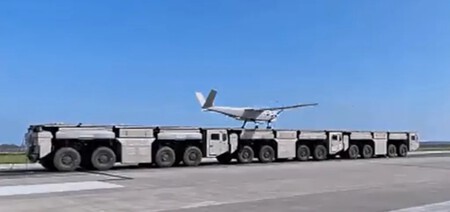
Capture of the recently released video, which shows the launch of a drone from the mobile electromagnetic catapult made up of several trucks
The catapult is just one part of a broader family of containerized military systems. Material attributed to the School of Mechanical Engineering at the Beijing Institute of Technology includes modules with anti-ship missile launchers, land attack missiles, surface-to-air missiles, close-in defense systems, radars, electronic warfare capabilities, and command and control systems. Additionally, containers designed to transport a catapult truck and a disassembled drone also appear. According to that publication, the aim is to produce 2,000 containerized systems per year.
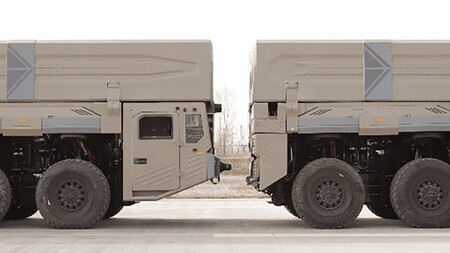
Capture of the recently released video
The emphasis on an electromagnetic catapult is noteworthy, as China has already made strides in this technology with the Fujian, an aircraft carrier that represents its leap towards catapult operations and deck recovery. This context highlights the mobile system’s significance: it is not an isolated technical oddity but part of a broader commitment to expand aviation capabilities. The Type 076 Sichuan, an amphibious assault ship associated with drone operations, aligns with this vision.
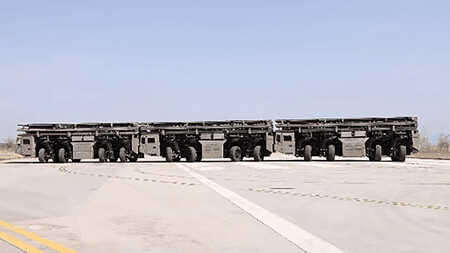
Capture of the recently released video
This innovative concept aims to enable assisted launches in areas without a conventional runway or where such runways are too vulnerable. Potential deployment locations include islands, remote areas, prepared roads, temporary bases, or ships with sufficient deck space. While it cannot replace a complete aerial infrastructure, it facilitates the closer deployment of light drones to specific operational areas. In such scenarios, reducing the distance that a drone must travel from a distant base is critical.
However, many uncertainties remain. Questions persist regarding the electrical power requirements, logistical footprint, how drones are charged prior to launch, and the actual operational cadence outside a controlled demonstration. There are also concerns over potential maritime use; successfully launching drones from a moving ship poses stability challenges. The gap between showcasing a demonstrator and achieving a functional military capability remains considerable.
Images | Beijing Institute of Technology/WeChat