

Beijing, we have a problem. The Asian giant has made significant strides to compete with the United States in the realm of Artificial Intelligence (AI). However, it is losing a crucial battle in the field of investment . While China has made notable advancements, its rival is not just outpacing it; it is dominating the landscape.
Investment gap. Outperforming in AI involves excelling in diverse sectors. Although China has successfully navigated several challenges and is competing with the US in model capabilities, a crucial issue holds it back: China’s tech companies are not investing at the same scale as their American counterparts. This investment gap has significant implications for the future of AI development.
The US capex is astronomical. In the last five years, tech giants like Google, Microsoft, Meta, and Amazon have amassed a capital expenditure (capex) of 5.36 trillion yuan. In contrast, the seven major Chinese tech companies—including Tencent, Alibaba, Baidu, and JD.com—combined invested a total of 630 billion yuan. This stark difference has been growing over time; data from Jinduan Research Institute indicated that in 2020, the capex ratio of the US compared to China was 1:6, but it is now nearing 1:10. This is not to say that China is investing less; rather, the US is investing significantly more .
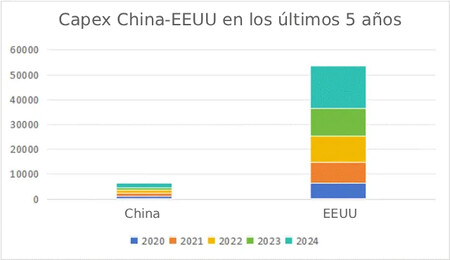
Source: Jinduan Research Institute
Data centers send. While not all capital expenditures focus on AI, a significant portion is dedicated to this burgeoning field. Major American tech firms have publicly announced massive investments in data centers. With Amazon alone planning to invest $100 billion and Microsoft committing $65 billion, the figures are staggering and highlight the trend towards prioritizing AI infrastructure.
Network effect. The network effect is another challenge faced by China’s AI ambitions. This phenomenon occurs when a product or service becomes increasingly valuable as more users engage with it. The substantial US investments are leading to the development of superior models that, in turn, attract more users and generate vast amounts of data. This data helps refine AI algorithms, creating a feedback loop that continues to improve user engagement and model effectiveness.
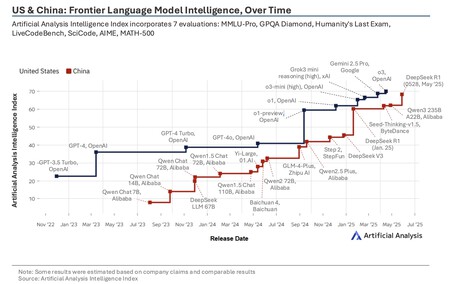
The quality of AI models in China compared to the US is significantly highlighted in several benchmarks. Source: Artificial Analysis.
Adoption rate. According to the Jinduan report, the rate of AI adoption among US companies is reportedly at 78%, whereas China’s rate is lamentably low at just 15%. Data from McKinsey indicates that over a billion users in the US utilize AI chatbots, including platforms like ChatGPT, which alone boasts approximately 700 million users. In contrast, Chinese chatbots seem to have only about 70 million users, raising questions about the accuracy of this data.
China (probably) would like to spend more, but can’t. It is unclear whether the low adoption rate causes the reduced capex or vice versa. However, it is certain that Chinese companies would likely increase their investments if circumstances allowed. The stringent export controls resulting from the ongoing trade war with the US severely limit Chinese companies’ ability to acquire advanced AI chips and components, thus restricting their potential growth in this pivotal area.
Dividends. According to the Jinduan report, another reason behind the dissonance in capital expenditure is that Chinese firms tend to allocate their profits towards buybacks and dividends rather than investing in development. For instance, Tencent’s total net expenditure on share repurchases and dividends in 2024 is projected to reach 1.68 billion RMB, doubling its investment in capital expenditures for that year.
In summary, while the US is racing ahead in the AI investment race, China finds itself in a quagmire, grappling with investment discrepancies and restrictive regulations. The so-called “AI deflation” in China signals a potential long-term crisis, where underinvestment and inadequate adoption rates could limit the nation’s ambitions to become a powerhouse in artificial intelligence technology.
Image | Karolina Grabowska