
The Ibones de Anayet are a stunning collection of small glacial lakes nestled in the breathtaking landscape of Sallent de Gállego, located in the Aragonese Pyrenees . To biologists, these lakes are considered natural jewels ; for mountaineers, they serve as serene resting spots and recreational havens. However, this beauty has become a double-edged sword. As the popularity of the ibones soared on social media, they have increasingly attracted crowds of tourists, some of whom do not adhere to regulations meant to protect these delicate ecosystems. Reports have surfaced of people camping without permission , bathing where they shouldn’t, and even using drones to capture aerial photos of the stunning scenery.
In response to the growing tourist influx , authorities have had enough.
Rain of fines. What started as a quiet weekend in the Aragonese Pyrenees quickly devolved into a significant enforcement operation. Agents from the Seprona of Huesca worked alongside nature protection officers in Aragon, leading to a remarkable 86 fines over two days. Their investigation revealed 46 illegal campsites established in the vicinity of the Ibón de Anayet.
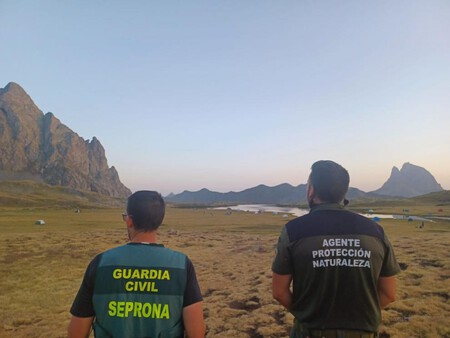
</div>What motivated these fines? In a statement made by the Aragonese government, it was clarified that the hikers had set up their camps without prior notification to the authorities or the Emergency Center 112. Furthermore, many of these camps were situated less than 100 meters from the lake’s Security Strip .
“The Anayet ibón and its surroundings are part of a protected natural space . Camping is allowed only under specific conditions and with express authorization to preserve the ecosystem and protect flora and fauna,” emphasized the Autonomous Executive.
An environmental jewel. The ibones are small, mountain lakes of glacial origin scattered across the Aragonese Pyrenees. The Anayet ibón, in particular, is located within the municipality of Sallent de Gállego , in Huesca. The uniqueness of these bodies of water creates an urgent need for protective measures, particularly due to the increased popularity they have gained.
“The problem is that when hundreds of people converge at a single site for activities like swimming or picnicking, damage is inevitable,” warns Fran Gómez, Director of the Province of Environment and Tourism in Huesca. “Not only is bathing prohibited, but the use of sunscreens also leaves harmful residues in the water.” Thus, authorities urge visitors to ensure they have the “minimum documentation” before embarking on their excursions.
@diariovasco The biologist Lorena Escuer utilizes her social media platforms to denounce the illegal camping occurring at Ibón de Anayet. Easily accessible via the Formigal ski slopes, this location is not only stunning but also home to delicate flora and fauna. Prohibitions against camping and bathing exist to protect these natural treasures.
“A remarkable increase”. The recent enforcement operation was not a random act. The government has acknowledged a significant uptick in the number of people camping in the area, driven primarily by the promotion of the ibones on social media and the marketing tactics of certain companies.
“The decision to mobilize enforcement followed the verification of a notable increase in nighttime visitors, fueled by promotional efforts from various companies that charge for camping without the requisite permissions,” authorities noted.
“A huge speaker”. Despite tourism in the Aragonese Pyrenees not being new, the popularity of visits to Ibón de Anayet has skyrocketed. “Social media acts as a giant speaker, broadcasting the availability of this beautiful, accessible location,” Gómez remarked.
Furthermore, a quick search on the internet reveals multiple companies that offer free camping and excursion services in the region.
Is it something new? The operational crackdown was contextualized by rising concerns. In late July, several local environmental organizations and mountaineers voiced alarms over the saturation of the Aragonese ibones. One local mountaineer noted, “Upon arriving at Anayet’s Ibón, I observed 18 tents , people swimming, and drones flying overhead,” painting a concerning picture of overcrowding.
The allure of the environment combined with its relative accessibility has made the ibón a favored destination, labeled by some as the “most beautiful free camping site in the Pyrenees.” The hyper-saturation of Ibón de Anayet has been openly criticized on social media platforms by biologist Lorena Escuer, who even documented the presence of drones and unlawful bathing activities.
“These ibones are not only exquisite but also fragile ecosystems home to rare high-altitude flora and fauna. Yet at 2,200 meters, the dominant species during summer appears to be human,” she lamented.
Images | Mauri (Flickr) and Aragon Government
In Xataka | Aragon’s ski stations are facing significant pressures. One has even explored a creative solution: building the largest toboggan in Europe to attract visitors.