
The Marvel of Brueghel’s ‘Air’
The 17th-century painting ‘Air’ by Jan Brueghel the Elder is not just an exquisite display of mythological themes but also a fascinating study in early zoology. The artwork features Apollo navigating the sky in a chariot, accompanied by the muse Urania holding an armillary sphere, while an array of birds fills the backdrop. What modern researchers have uncovered is extraordinary: this painting contains intricate details that make it a remarkable document of animal behavior, predating scientific discoveries by over 400 years.
A Hidden Mastery: Chiropterology in Art
Remarkably, Brueghel showcased an understanding of chiropterology— the study of bats— that astonishes contemporary zoologists. The painting boasts over 60 bird species, alongside representations of bats, including the Nyctalus lasiopterus, known as the “giant noctule.” This bat species can have a wingspan of up to 46 cm.
Subtle Details and Scientific Insights
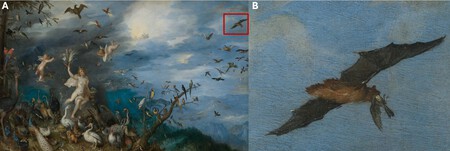
Beyond artistic mastery, Brueghel’s ‘Air’ remains a treasure trove for ecological and zoological studies. The fine details in the painting invite scrutiny, revealing more about the fauna of centuries past. Research conducted by a team from the Doñana Biological Station, led by Pedro Romero-Vidal, focused on identifying animal representation in historical art. When he examined Brueghel’s work, he was struck by a distinct detail: a large bat appears in the upper right corner, catching the attention of experts.
A Revelation in the Boughs of History
The analysis revealed that the bat depicted is not simply airborne; it carries a small bird in its jaws, a behavior that science only began to understand in detail in the 21st century. Researchers had long suspected that Nyctalus lasiopterus preyed on passerine birds but could only verify this behavior fully decades later. Indeed, it wasn’t until 2025 that modern science could substantiate Brueghel’s artistic observations.
A Groundbreaking Discovery
The team’s findings, published in PNAS, demonstrate that the giant noctule has the capability to hunt birds in mid-flight, showcasing a biological behavior that Brueghel represented nearly four centuries ago. This paints a compelling picture of how astutely the artist captured the natural world, although there are nuances to consider. The CSIC emphasizes that while Brueghel’s depiction is astoundingly prescient, it doesn’t align perfectly with our understanding of bat behavior today.
Art as a Scientific Resource
Despite the discrepancies in how bats actually hunt, Brueghel’s work underscores the potential of art as a lens into the natural world. Brueghel the Elder’s painting exemplifies how an artist’s keen observation can transcend time, offering invaluable insights that can enrich our understanding of zoology and ecology.
In conclusion, Jan Brueghel the Elder’s ‘Air’ is more than a captivating painting; it stands as a historical document of biological behavior and illustrates how art can bridge the gap between aesthetic expression and scientific inquiry.