
Evaluating the Latest in AI: Anthropic’s Claude Sonnet 4.6 vs. Gemini 3 Pro and GPT-5.2
Artificial intelligence (AI) has become an integral part of our daily lives, especially in the tools we choose for various tasks. Among the frontrunners in this field are Claude by Anthropic, Gemini, and GPT models. Each comes with unique strengths, prompting the question: are the latest enhancements worth exploring, or has your current AI model sufficed thus far?
Claude Sonnet 4.6: Key Improvements
Claude Sonnet 4.6 brings a host of improvements that enhance its usability. Anthropic describes these improvements as transversal, covering advances in coding, long-context reasoning, agent planning, and typical intellectual and creative tasks. One standout feature is its context window, which can reportedly handle up to one million tokens in beta. This allows the model to process expansive data sets, such as entire code bases and extensive contracts, without losing coherence.
Model Hierarchies: Understanding Sonnet’s Position
To effectively evaluate Sonnet 4.6, it’s essential to grasp Anthropic’s framework of model organization. The company’s models are categorized into three levels:
- Haiku: Focuses on speed and efficiency.
- Opus: Designed for deep reasoning tasks.
- Sonnet: Positioned between the two, offering a balance of capacity and cost.
Interestingly, Sonnet 4.6 claims to approach the performance of Opus in specific tasks, presenting a bold assertion from Anthropic.
Human-like Computer Interaction
A significant enhancement in Sonnet 4.6 is its ability to use computers autonomously. This means it can interact with software similarly to a human user, without the need for specialized automation APIs. Supported by OSWorld-Verified testing, this advancement showcases steady improvement, though the company warns about risks such as prompt injection.
Benchmark Evaluations: Choosing the Right Model
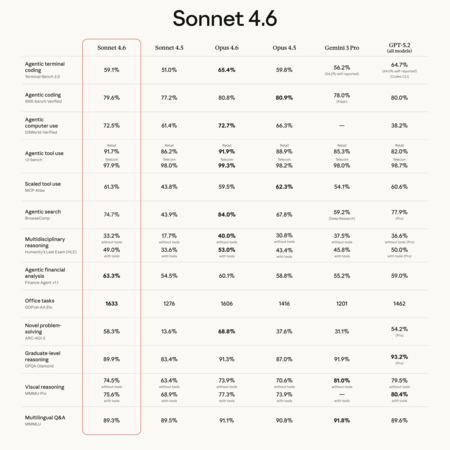
At this juncture, comparing Sonnet 4.6 with its competitors—GPT-5.2 and Gemini 3 Pro—becomes paramount. Each AI excels in different domains, making it challenging to declare a single “winner.”
Sonnet 4.6 vs. GPT-5.2
In direct comparisons:
Strengths of Sonnet 4.6:
- Autonomous computer use (OSWorld-Verified)
- Office tasks (GDPval-AA Elo)
- Analysis and problem-solving scenarios (Finance Agent v1.1, ARC-AGI-2)
Strengths of GPT-5.2:
- Graduate-level reasoning (GPQA Diamond)
- Visual comprehension (MMMU-Pro)
- Terminal programming (Terminal-Bench 2.0)
Sonnet 4.6 vs. Gemini 3 Pro
When matched with Gemini 3 Pro, the dynamic shifts:
- Sonnet 4.6: Retains advantages in practical work and scenarios utilizing external tools.
- Gemini 3 Pro: Excels in reasoning and general knowledge, outperforming in graduate-level reasoning tests and multilingual assessments.
Practical Applications of Sonnet 4.6
Sonnet 4.6 is available across all Claude plans, including a free tier, and is integrated within Claude Cowork and Claude Code APIs. It maintains the same pricing structure as its predecessor, Sonnet 4.5.
Conclusion: Fragmentation in AI
After reviewing capabilities, constraints, and comparative analysis, the crucial decision rests on user needs. Sonnet 4.6 shines in productivity tasks and software interaction, while GPT-5.2 and Gemini 3 Pro hold advantages in academic and visual tasks. This fragmentation illustrates the current landscape of AI technology, where no single model can dominate all areas.