
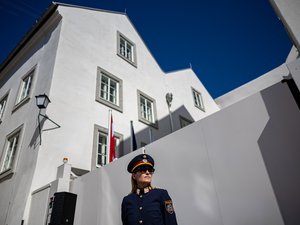
Austria has taken a significant step by inaugurating a police station in Braunau-am-Inn, the birthplace of Adolf Hitler, on July 22. This transformation, costing approximately 20 million euros, aims to deter neo-Nazi gatherings and address years of controversy surrounding this historically significant site.
## A New Chapter for Braunau-am-Inn
The decision to convert the building, which has long been associated with Hitler’s legacy, reflects Austria’s commitment to confront its past. Mayor Johannes Waidbacher remarked that this initiative signifies the town’s willingness to accept responsibility while looking forward to a peaceful future. He expressed hope that the police station would foster serenity among residents after years of divisive debates.
A small ceremony marked the occasion, attended by around a hundred people, including several uniformed police. Notably, 90-year-old resident Erna Seidl was among those who celebrated this transformation, feeling “relieved” and “very happy with the result.”
## “The Memory Does Not Disappear”
The building, dating back to the 17th century, has undergone significant renovations that have actively transformed its appearance, moving from its former yellow facade to a more subdued white profile. The entrance now features a police logo, while a commemorative stone on the sidewalk reads: “For peace, freedom, and democracy. Never again fascism. Millions of deaths remind us.”
Interior Minister Gerhard Karner has emphasized that while the building’s function may change, “the memory does not disappear, nothing is hidden.” This underscores the notion that confronting the past is crucial for the future.
## Confronting a Dark Legacy
Austria has often faced criticism for its delayed acknowledgment of its responsibilities concerning the Holocaust. With 65,000 Austrian Jews killed during this time, the country has been on a complex journey of reflection regarding its Nazi past. This becomes increasingly relevant as far-right sentiments gain traction; recent polls indicate that the FPÖ party, linked to former Nazi ideologies, has garnered 38% of voting intentions.
The building itself has been a point of contention for decades. Owned by the same family since 1912, it was rented to the Austrian state in 1972, initially serving as a center for the disabled—a group targeted by the Nazis. The last private owner resisted any transformation, but Austria eventually enacted a special law to facilitate a change, which was validated by the Supreme Court in 2019.
## A Mixed Reception
Despite this positive step, reactions remain mixed. Florian Kotanko from the Contemporary History Association of Braunau pointed out that Braunau will always be remembered as Hitler’s birthplace, suggesting that the inauguration of a police station might not erase this association. Moreover, Robert Eiter from the Austrian Mauthausen Committee expressed skepticism that this transformation would deter neo-Nazi gatherings.
Concerns have also been raised about the police force’s political leanings, with some arguing that a portion of the police leans toward far-right ideologies. However, Andreas Pilsl, the director of regional police, has stated that there is a collective awareness among officers regarding the historical significance of the site where they work.
## Conclusion
The establishment of a police station in Hitler’s birthplace marks a complex yet necessary undertaking for Austria, blending the urgency to combat neo-Nazi sentiments with the imperative to confront the haunting shadows of history. The phrase, “The memory does not disappear,” will continue to resonate, reminding residents and officials alike of their shared past as they navigate the delicate balance between remembrance and progress.