
| IN BRIEF |
|
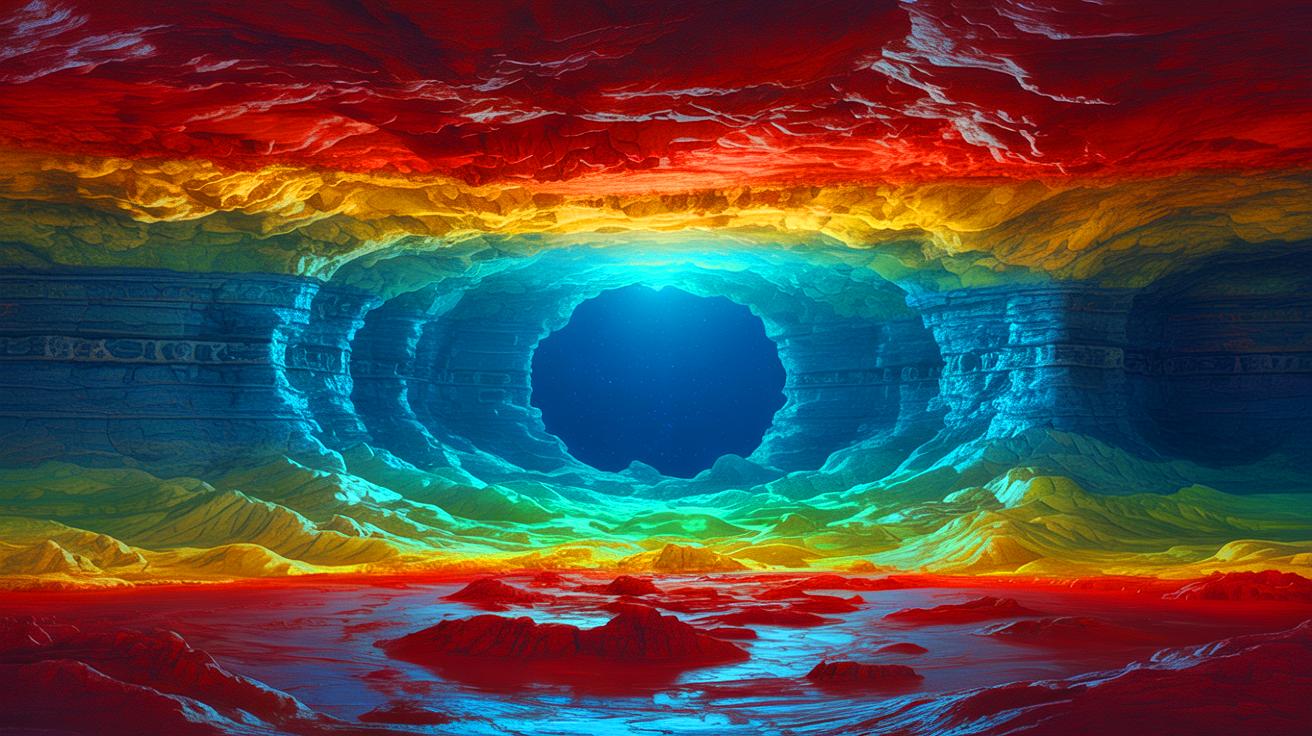
The scientific exploration of our planet continues to unveil astonishing wonders, and the recent discovery of a vast reservoir of water hidden deep beneath the Earth’s surface exemplifies this breathtaking adventure. As humanity reaches out to the universe, contemplating black holes and distant galaxies, it’s fascinating to recognize that our Earth still harbors equally captivating mysteries. The identification of a buried ocean nearly 400 kilometers deep challenges our understanding of the geophysical systems of our world and prompts us to reconsider the dynamics of water on our planet.
A Hidden Ocean in the Earth’s Mantle
At an impressive depth of 400 kilometers, a vast reservoir of water has been discovered, trapped within rock formations. While this isn’t an ocean in the traditional sense, it involves water contained in a mineral known as ringwoodite . This mineral acts like a sponge, absorbing and holding water within its unique crystalline structure. This revelation raises questions regarding the way water circulates inside the Earth. Unlike surface water, this reservoir isn’t found in liquid, solid, or gaseous forms but exists in a state where it is suspended within the rock, akin to moisture held in a sponge.
This extraordinary phenomenon has been corroborated by the work of geophysicists who have mapped this hidden water utilizing seismic waves generated by earthquakes. The results demonstrated that waves traversing this region of the mantle were altered by the presence of water locked away in the ringwoodite, providing crucial insights into the amount of water that could be stored beneath our feet.
Why filtering the water we drink is more important than ever?
The Implications for the Earth’s Water Cycle
This discovery paves the way for a revisitation of the Earth’s water cycle. Until now, scientists have focused on the visible water cycle encompassing oceans, rivers, and lakes. However, the existence of this immense hidden reservoir may indicate a global water cycle that extends into much deeper dimensions. According to lead researcher Steve Jacobsen, this hidden water may explain how so much water has surfaced on the Earth. Understanding this global cycle could also shed light on the mechanisms behind water formation on other planets and moons, where similar reservoirs might exist.
This perspective on deeply buried water enriches our comprehension of the geological and climatic processes of our planet. It might also hold significant implications for predicting natural disasters such as earthquakes and volcanic eruptions, offering new clues about tectonic movements and the internal pressures of the Earth.
The Research Behind the Discovery
The discovery of this hidden ocean is the result of meticulous and prolonged research. Scientists analyzed seismic waves captured by seismometers spread across the globe. These instruments detected anomalies in the way waves traversed certain deep regions of the mantle, leading researchers to suspect the presence of water. By studying these waves, they confirmed that water was indeed trapped within the ringwoodite, a mineral rarely observed at the surface but abundant in the mantle.
The research process also involved laboratory experiments aimed at recreating the extreme pressure and temperature conditions of the Earth’s mantle. Researchers utilized synthesized samples of ringwoodite to demonstrate its capacity to absorb and retain water, thereby affirming the seismic observations. This combination of empirical data and experimental simulations validated the hypothesis of a massive underground water reservoir.
Other Hidden Sources of Water in the Earth’s Crust
In addition to the hidden ocean in the mantle, other concealed sources of water exist within the Earth’s crust. Mineralized waters are trapped within the crystalline structure of minerals like olivine and serpentine. Additionally, deep aquifers contain ancient water, sometimes imprisoned for millions of years. Subduction zones, where tectonic plates overlap, also serve as potential reservoirs, drawing water from the oceanic crust down into the mantle.
Cavities and porous spaces within rocks allow water to infiltrate deeply, creating underground reserves. Finally, mantle-derived water released by volcanic activity contributes to these hidden resources. These reservoirs play a crucial role in geological processes, influencing tectonic movements and the global hydrological cycle.
| Hidden Water Source | Description |
|---|---|
| Mineralized Waters | Trapped within the structure of minerals |
| Deep Aquifers | Ancient water imprisoned in porous rocks |
| Subduction Zones | Water forced into the mantle by tectonic movements |
| Mantle-derived Waters | Water released by volcanic activity |
The Earth continues to surprise us with its buried mysteries. The discovery of this hidden ocean within the Earth’s mantle invites us to rethink our understanding of the planet and its internal processes. By revealing new dimensions of the water cycle, this discovery opens exciting avenues for geological and climatic research. What other secrets does our planet hold, waiting to be unveiled by the next generation of curious scientists?
The author relied on artificial intelligence to enrich this article.
Did you like it? 4.5/5 (21)