
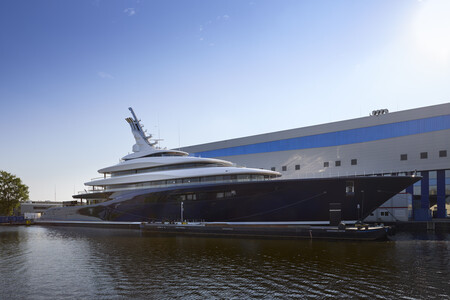
At first glance, Breakthrough might appear to be just another superyacht flaunting its grand dimensions. Measuring a staggering 118.80 meters and constructed by Feadship, it falls into the category of luxury vessels filled with swimming pools, terraces, and private areas. However, the real marvel of this yacht lies beneath its polished exterior: a cryogenic system designed to accommodate liquid hydrogen at a chilling -253 ºC.
Unveiling Project 821
Initially referred to as Project 821, Feadship unveiled it in 2024 at its Amsterdam shipyard. This yacht is labeled as the first superyacht incorporating a hydrogen fuel cell system, emphasizing Feadship’s commitment to exploring non-combustion electricity generation technologies within platforms exceeding 100 meters.
The Secret Below Deck
Transporting liquid hydrogen isn’t merely a matter of swapping tank types. Breakthrough includes a 92 m³ cryogenic tank capable of storing approximately four tons of hydrogen, housed in a dedicated and highly insulated space. This choice poses a challenge, as liquid hydrogen occupies substantially more volume compared to conventional fuels, estimated to be eight to ten times greater than a non-fossil diesel equivalent.
Unlike traditional fuels, hydrogen does not combust in the same manner. Instead, it is processed through 16 PowerCell systems, which act like compact power plants, combining hydrogen with oxygen to generate electricity while emitting only water vapor. The electricity produced powers a system integrated by ABB, comprising a direct current electrical grid, intelligent energy management, and Azipod thrusters. Essentially, hydrogen does not propel the yacht directly; rather, it generates the power necessary for movement and onboard consumption.
Extravagant Amenities
Despite its groundbreaking technology being concealed, Breakthrough doesn’t compromise on luxury. Feadship has incorporated more hull openings than any prior project, featuring 14 balconies, seven platforms, and nine hull doors. Potential buyers can indulge in a swimming pool, three hot tubs, a Nemo lounge, a spa, cinema, hospital, touch-and-go helipad, and three elevators.
Hybrid Operating Conditions
A crucial question arises regarding whether Breakthrough operates solely on hydrogen. The answer is no. Feadship markets it as a hybrid yacht that utilizes hydrogen energy in specific scenarios. This vessel can operate quietly at anchor or navigate protected waters at 10 knots without fossil fuels for up to a week. This capability, while impressive, underscores the limits of hydrogen: it minimizes noise and local emissions without completely eliminating the need for conventional systems.
Space Constraints
Even within its substantial 118.80-meter frame, space limitations prevent the yacht from carrying enough liquid hydrogen for a full oceanic crossing. Therefore, Breakthrough uses fuel cells in conjunction with MTU generators capable of running on HVO, a second-generation biofuel, forming a hybrid power architecture.
Safety and Regulatory Measures
The project also serves as an intricate exercise in integration, given that no specific class, Flag State, or IMO regulations existed for hydrogen storage and fuel cell systems at the time. Feadship collaborated with Lloyd’s Register to formulate special equipment, protocols, and safety measures. ABB contributed to this aspect by integrating the 3 MW system with the Onboard DC Grid network, energy management solutions, and Azipod thrusters.
Infrastructure Challenges
Beyond the yacht itself, another significant challenge lies in creating the proper infrastructure for safely supplying liquid hydrogen. In 2025, Air Products successfully bunkered Breakthrough with liquid hydrogen, marking the first instance of this type in the Netherlands. This milestone highlights the need for ports capable of managing fuel at extreme temperatures, emphasizing that hydrogen technology requires more than just onboard systems.
A Future of Maritime Energy
Breakthrough illustrates that navigating the complexities of hydrogen technology—storage, regulation, integration, and infrastructure—can transition from theoretical discussions to practical applications in real maritime vessels. Although it may remain a unique showcase for years, its development has thrust pivotal conversations about future maritime energy into the limelight.
Images | Feadship