

If we have the roads we have today, it was because 125 years ago a Scottish and a Welsh individual were fed up with the dusty roads during the nascent years of the automobile. Consequently, these pioneers initiated the asphalting of numerous paths, some of which became integral to the country’s infrastructure. However, as time progressed, many of these roads fell into disrepair, overshadowed by modern highways. In an effort to revive these historical routes, the Government of Spain is now taking action to give them a second life.
Across the nation, numerous national roads are in a state of disrepair. While maintenance budgets are often allocated to the most-used highways, many lesser-traveled roads have been neglected . To address this issue, the Spanish Government is set to launch a program in 2025 aimed at recovering and preserving these historical roads, starting with a section of the N-IV that winds through Despeñaperros .
Spain and Its New “Historical Roads”
At the beginning of September this year, the Ministry of Transport and Sustainable Mobility , together with the Foundation of the Spanish Railways , signed a collaboration agreement with an important goal: the restoration of historical roads within the State Road Network.
The initiative aims to identify certain routes as “historical assets linked to transport,” emphasizing their historical significance in fostering population movement and trade before being replaced by modern alternatives. The agreement allocates a budget of 300,000 euros , funded partially by the Ministry of Transportation and the Foundation of the Railways, to identify which routes are suitable for designation as “historical roads” over the next four years.
This project mirrors the success of the ‘Green Roads’ program, which has transformed over 3,500 kilometers of old railway paths into trails for non-motorized use. Many municipalities benefit from these Green Ways , which offer scenic paths for hiking and biking, complete with shade trees and parks.
Similar objectives are intended for the new historical roads initiative, aiming to halt the deterioration and eventual loss of these unique routes while enhancing their value in the historical infrastructure of Spain. The project, dubbed Ivapchete , will also prioritize the roads based on their heritage value and associated elements.
Although the initial focus is on the Spanish road network, the program might expand to include roads managed by other governmental bodies if they share historical ties with the state network.
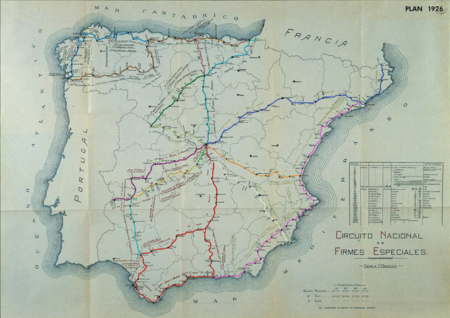
Perhaps the Map of the National Special Firm Circuit of 1926 can give us a clue about other candidates.
Additionally, a pilot project is already underway: the Despeñaperros initiative. In the coming months, the General Directorate of Roads will develop a recovery project for the N-IV road segment, specifically the Despeñaperros Pass . This 28.6-kilometer stretch connects Almuradiel , Ciudad Real, and Santa Elena , Jaén.
The historical significance of this route cannot be overstated; it has long served as the principal access point between Castilla-La Mancha and Andalucía . Serving as a symbol of territorial unity , it facilitated both trade and mobility between the central plateau and the southern region of Spain. Historically, before it was designated as N-IV , it functioned as a critical artery for centuries until it was eclipsed by the more convenient A-4 highway.

Now, it will come back to life as the first “historical road,” promoting non-motorized mobility while recognizing its cultural importance. The impact of this revitalization, along with the potential for recovering other significant routes, remains to be seen.
Images | Emilio J. Rodríguez Posada, Concepcion Amat orta
In Xataka | These are the roads where we can suffer more jams in summer. If you have to take the car, you are in time to plan.