
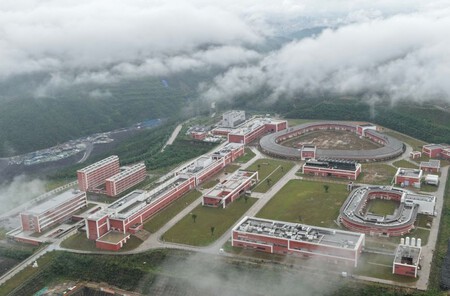
There are machines built to observe the known and others designed to explore the unknown. In Huizhou, China has raised an impressive facility featuring a two-kilometer beam line capable of accelerating heavy ions and targeting atomic nuclei with unprecedented intensity. While it might seem like an infrastructure solely for nuclear physicists, its potential extends far beyond conventional nuclear research.
Unveiling the High Intensity Heavy Ion Accelerator Facility (HIAF)
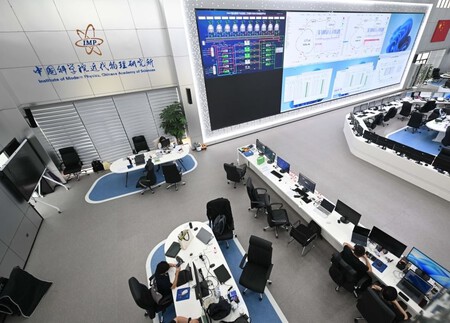
A significant milestone was reached on July 21, when the High Intensity Heavy Ion Accelerator Facility, or HIAF, passed its acceptance review, affirming that it met its construction objectives and commenced trial operations for scientific research. Built by the Institute of Modern Physics of the Chinese Academy of Sciences, the project began its development in December 2018 and successfully generated its first beam in October 2025. With construction complete, the focus now shifts to scientific exploration.
Architecture and Functionality of HIAF
The HIAF is not merely a linear track for particle acceleration. Its design integrates three core systems: a superconducting linear accelerator that provides intense beams in either continuous or pulsed mode, a synchrotron for ion accumulation and energy enhancement, and a storage ring that preserves ions for precise measurement by researchers.
The operation begins with ions—atoms stripped of one or more electrons, which can be steered using electric and magnetic fields. It is noteworthy that the HIAF stands out as the first advanced heavy ion facility to integrate these three technologies.
A Facility for Cosmological Exploration
Many of the heavy elements we encounter in our universe remain a mystery in terms of their formation. Researchers at HIAF aim to address these uncertainties by generating unstable nuclei, studying their behaviors, and probing the limits of nuclear matter cohesion. This groundbreaking work not only aims to widen the periodic table but also seeks deeper insights into cosmic processes that yield elements such as uranium.
Complex Applications Beyond Nuclear Physics
The accelerator’s beams are not limited to nuclear investigations; they can also be employed to test chips and electronic components under high radiation. High-energy particles can wreak havoc on electronic circuits, corrupting data or causing permanent damage. By replicating these conditions on Earth, HIAF provides a controlled environment to evaluate the resilience of technologies intended for space missions.
Furthermore, the accelerator’s capabilities extend into medical applications and the study of radiation damage in materials designed for advanced nuclear systems or future fusion environments. While it is not intended as a power plant or medical institution, it serves a vital role in verifying what designs withstand or succumb to radiation.

Promising Outcomes and Future Research
The initial operational phase has already yielded remarkable figures, with beam intensities for oxygen and bismuth ions surpassing previous world benchmarks by factors of three and 7.5, respectively. The HIAF achieved beam commissioning along its two-kilometer track in just 16 hours, setting a record among similar facilities. Ongoing tests are examining nuclear masses, radioactive beam production, nuclear structure, and material irradiation.
The HIAF represents a vital leap towards uncovering the mysteries of our universe while simultaneously advancing technology that can influence various fields. As testing continues, the potential for new discoveries grows, and the facility may soon become a cornerstone of scientific exploration.
Images | Institute of Modern Physics of the Chinese Academy of Sciences