
Let’s go back to 1949. A young mathematician named John Nash found an original idea for his thesis at Princeton University. Game theory already existed thanks to the previous works (1944) by John Von Neumann and Oskar Morgenstern, but the von Neumann model focused on zero-sum games (one player wins, the other loses). Nash had a spark of genius in proposing that in any game there should be at least one point where no player could improve his situation by changing his strategy unilaterally. He formalized that idea in a short two-page article (‘Equilibrium Points in N-Person Games‘) in January 1950, and with it revolutionized history, including printers.
Is the printer the worst technological product in history?
Printers serve as an almost manual example to apply the concept of Nash equilibrium. These products have followed – at least, to a large extent – the economic model of “machines and blades”: you sell the printer cheaply but charge exorbitantly for ink cartridges. Consumers know that an ink printer’s initial cost is economical, almost ridiculous. However, we have also accepted that the ink and cartridges for those printers will be extremely costly. If not, what ultimately occurs is a subscription to either the ink or the printers themselves.
In the last 30-40 years, we have witnessed how printers have possibly become the worst technological product in history. It’s not just that printers can get stuck or work erratically; the real issue lies in how manufacturers have protected their business models, making it incredibly difficult for users to use third-party cartridges and ink. The Nash equilibrium effectively explains why manufacturers act as they do.
Consider two major manufacturers like HP and Canon with two options:
- Expensive and blocked cartridges (the current model).
- Cheap and open cartridges (allowing competition and lower prices).
In this scenario, HP and Canon managers recognize three potential market outcomes:
- If both maintain expensive, blocked cartridges: they earn significantly.
- If one “opens” its cartridges and lowers prices while the other remains closed: the one who opens loses income, and the one who stays closed earns more.
- If both open: intense competition ensues, but both earn less.
Given these choices, manufacturers inevitably decide to keep their cartridge technology closed, as that maximizes profits for all involved.

Nash’s equilibrium fits this scenario perfectly: it shows a stable point for each player (the companies) but does not ensure the best outcome for society as a whole. Collectively, the optimal solution would involve opening up technology and lowering prices; companies would earn less, but the overall market would become larger and fairer. However, reality often takes a different route.
We need a “Tesla printer”
This printer user has thus been subjected to constant bleeding, resulting in unbelievably high expenses in cartridges as well as loss of time and productivity. What has transpired within the printer industry is extraordinary: we have normalized the perception that printers are more problematic than beneficial.
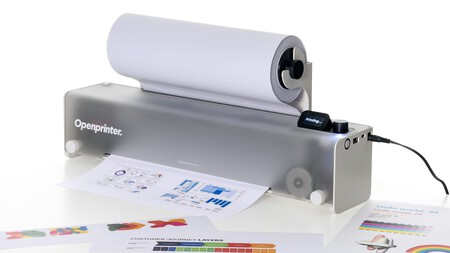
The Open Printer, a striking printer project “Open Source” based on the use of HP cartridges but accepting compatible third-party cartridges. Source: The Open Printer.
This creates a fertile ground for revolutionary possibilities in the printer market. There is a significant opportunity for a manufacturer willing to abandon the current Nash equilibrium and reimagine the industry. This field is ripe for a new player who provides ethics, transparency, and reliability. What the market desperately needs is a kind of “Tesla printer.”
A printer that can disrupt the segment similar to Tesla’s impact on the automotive industry must offer great design, reliable operation, and longevity, while also challenging the dictatorial cartridge philosophies currently in place. One ongoing project, The Open Printer, developed by the Paris-based startup Open Tooks, focuses on an open-source, repairable ink printer with modular parts for easier assembly and repairs.
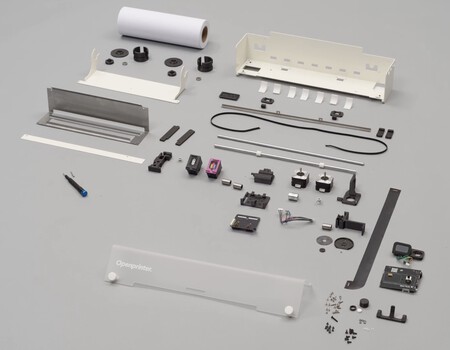
Source: The Open Printer.
The Open Printer uses a Raspberry Pi W as an operational core and lacks proprietary firmware or DRM cartridges. It’s designed for compatibility with HP63 cartridges (HP 302 in Europe), supporting both original and third-party inks. Moreover, it can handle not just A4 sheets but even 27 mm paper rolls.
While the price and availability of this innovative product remain under wraps, it is slated for a collective funding campaign, which is a reasonable approach despite the inherent risks associated with crowdfunding. One intriguing rumor even hints that Framework, the company renowned for its repairable laptops, is contemplating designing a modular, repairable printer!

This promising shift may spark a move towards a modular and repairable printer. If a company like Framework takes the plunge, we could finally see features such as replaceable print heads, rollers, or logic boards. This would significantly reduce programmed obsolescence and challenge the prevailing mentality of “discard and replace” when a minor issue arises.
If this transformation occurs, Nash’s equilibrium could be disrupted, prompting HP and similar manufacturers to rethink their current strategy. We might witness campaigns attempting to discredit the open-source printer, but established companies could be forced to create their own versions of modular, reparable, and “open ink” printers, even with some limitations to maintain control over the user experience.
Now it only remains to wait. With a bit of luck, Nash’s equilibrium will need to adapt to accommodate a new player and a revolutionary reality.