
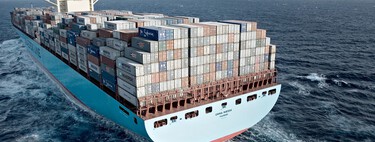
Much of the world economy moves by boat . It is estimated that between 80% and 90% of merchandise trade around the globe is transported via maritime routes, underscoring the vital role of shipping in global commerce. To sustain this immense logistical framework, we rely on giant container ships . These colossal vessels, often described as titans of the sea, have the capability to transport tens of thousands of containers simultaneously. Among these behemoths, the Megamax class stands out as the largest category of container ships to date.
One notable vessel within this class has recently shattered transport records: The One Innovation . It is the third-largest container ship in the world, boasting a staggering capacity of 24,136 TEU (Twenty-Foot Equivalent Units), second only to the OOCL Spain and MSC Irina . These ships represent the pinnacle of modern shipbuilding, rising from earlier models known as Ultra-Large Container Vessels (ULCVs), which frequently operated with a capacity of 20,000 TEU .
The Megamax vessels can accommodate between 21,000 and 25,000 TEU , reflecting the increasing demands of contemporary trade. They are capable of loading 24 rows of containers wide. The dimensions of these vessels verge on the limits of what channels like the Suez Canal can support—any significant increase in size could lead to navigation hazards. This reality poses substantial challenges for global logistics and necessitates upgrades or expansions at critical points along these trade routes.
One Innovation . This vessel features dimensions that bear comparison to significant landmarks: it is 399.95 meters long, 61.4 meters wide, with a depth of 33.2 meters and a draft of 16.5 meters . To visualize its massive size, consider that it can transport 25 levels of containers stacked high, with an arrangement allowing 24 rows along, another 24 rows wide, and around 2,000 containers fitted with cooling systems.
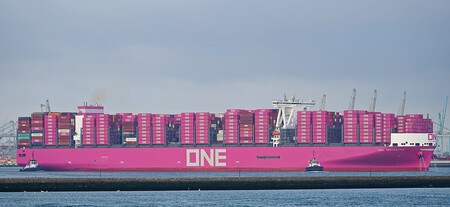
The other ships look like toys in comparison.
Record . Achieving maximum capacity on ships is a complex task. The mentioned vessels are nearly identical in terms of size, yet one may carry 200 containers more than another due to logistical considerations rather than hull dimensions. Essentially, it resembles an optimized game of Tetris . Recently, One Innovation not only set a record for capacity but also surpassed its earlier achievement of 22,000 TEU , loading 22,233 TEU in a single operation at the port of Singapore .
At 92% of its maximum capacity, the vessel has demonstrated its ability to load more. However, this feat isn’t achievable at every port. Designed primarily for the Asia-Europe route , it makes stops at crucial ports such as Xiamen, Rotterdam, Southampton , and Algeciras . Loading and unloading these enormous ships requires specialized port equipment, including cranes that extend around 70 meters and substantial docking facilities that can accommodate vessels up to 500 meters long.
Strategic Importance . The logistics required to handle these massive ships signify that not all ports are prepared to accommodate them. Incorporating advanced machinery, infrastructure, and safety protocols enhances the capability of ports to support such monumental operations. This sophisticated network is imperative for maintaining the supply chain that the global economy relies upon.

The need for ships of this caliber is not merely a trend but a necessity driven by the efficiency required in shipping vast amounts of goods in single voyages. This strategy not only cuts down on the number of trips required but also enhances energy efficiency. As the New Silk Route , promoted by China, evolves with aim to establish efficient trade links between Asia and Europe—and more recently with Africa—these massive vessels are poised to play an integral role in reshaping global trade dynamics.
Images | Shotbyp4ul, Kees Torn
In an era where the intricacies of global supply chains are continually challenged by shifting political landscapes and economic needs, the emergence of Megamax vessels symbolizes both the innovation and adaptability of the maritime industry. With vessels like One Innovation , the potential for further optimizing shipping routes and capacities suggests that the future of maritime logistics is set for extraordinary evolution.