
In 2021, the portable panorama was bleak in a key section: the right to repair . Manufacturers made it increasingly difficult to solve problems or update machines on one’s own. It was during this challenging landscape that a small and relatively unknown company presented an alternative. That company was Framework .
Framework’s modular laptops have since emerged as an absolute reference in repairability and expansion capacity . Over the years, they have maintained this tradition. Recently, the company announced the launch of two new portable models, alongside a surprising addition: a desktop mini-PC that, curiously, seemed contrary to the company’s principles.
<img alt="Framework Modular Laptop" width="375" height="142" src="https://i.blogs.es/d5ce75/framework-13-review-xataka-portada-alternativa/375_142.jpeg"/>This innovative machine is none other than the Framework Desktop. It distinguishes itself both externally and internally. The device adopts a mini-PC format with a mini-ITX motherboard and a compact chassis that occupies just 4.5 liters .
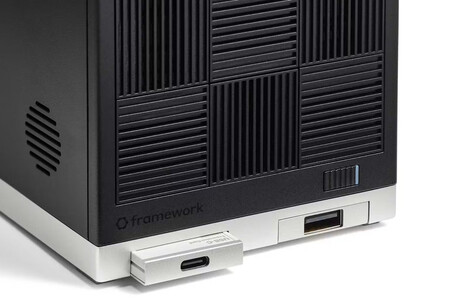
Moreover, the Framework Desktop boasts a differentiating design featuring a front panel where users can customize up to 21 “tiles” , which can even be printed in 3D . (The designs for customization are available online: GitHub Repository).
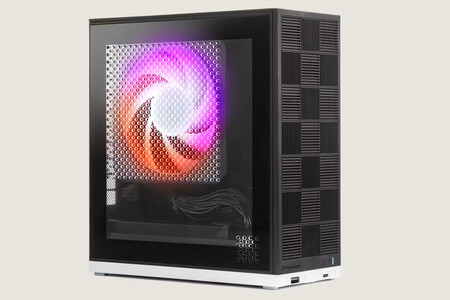
</div>In addition, the Desktop continues the tradition of modular ports found in Framework’s laptops, allowing users to customize their input and output options. Users can purchase these modules separately and integrate new ones as needed. On the inside, the technical specifications reveal a powerhouse:
AMD Ryzen AI Max+ 395 (16 cores, 32 threads, up to 5.1 GHz) | |
|---|---|
GPU | Radeon 8050s Graphics (32 nuclei, 2.8 GHz) Radeon 8060s Graphics (40 cores, 2.9 GHz) |
NPU | Up to 50 tops |
Memory | 32/64/128 GB LPDDR5X-8000 (Welded) |
Storage | Flexatx 400W |
Front ports | 2 x customizable I/O modules |
Rear ports | 1 x HDMI 2.1 2 x DisplayPort 2.1 2 x USB-C (USB4) 1 x RJ45 (5GBE) 2 x USB-A (USB 3.2 GEN1) 1 x minijack 3.5 mm |
Feeding | Flexatx 400W |
Dimensions and weight | 96.8 x 205.5 x 226.1mm 3.1 kg 4.5 L mini-ITX box |
Price | From 1,309 euros |
However, in these specifications, it’s surprising that the AMD SoC (with the CPU, integrated GPU, and NPU) is soldered to the motherboard, as is the memory. This seems like a betrayal of Framework’s core values of interchangeability and repairability, and has already drawn criticism.
An AI Workstation for All Audiences
Some independent reviews have criticized this aspect of the framework. However, the decision stems from a technical necessity. As the company explained in the official announcement:
“To enable the huge 256 GB/s memory bandwidth offered by Ryzen AI Max, the LPDDR5X was welded. We spent months working with AMD to explore solutions, but ultimately concluded that modular memory with high performance wasn’t technically viable with the 256-bit memory bus.”
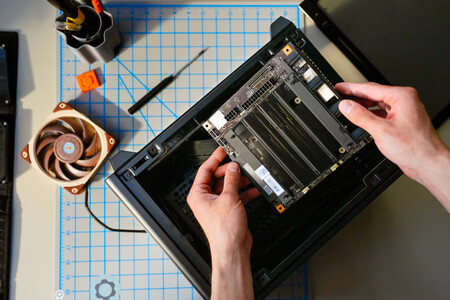
</div>This is a reasonable argument, especially given that while the device has a gaming flair, its true target audience is different. The machines leverage a unified memory architecture (UMA) , meaning there is no dedicated video memory; instead, the GPU utilizes RAM as video memory. Thus, 32, 64, or 128 GB of RAM is shared between CPU and GPU. This concept mirrors Apple’s approach with its M1 and M2 chips, allowing flexible assignment of memory resources between CPU and GPU.
The true value of these machines lies in being affordable workstations capable of handling local AI models . Recently, we discussed how OpenAI’s GPT-Oss-20b model demonstrated the importance of having significant graphic memory for such scenarios.
</div>The Framework Desktop presents a strong alternative to Apple’s computers with their unified memory architecture. For instance, if you opt for the 128 GB RAM model (€2,359), you could allocate up to 112 GB for video memory. This offers ample capability to work with heavy models like OpenAI’s “Large” variant (GPT-Oss-120b), or as noted by Framework, with Azure AI models.
In fact, the value proposition of this machine lies in its compactness and efficiency; it maintains a low power consumption of around 140W and operates quietly. This is not a rival to gaming machines with dedicated graphics. If your focus is serious gaming, this might not be your best bet.
However, if you’re more of an occasional gamer and primarily seek a powerful workstation that enables local AI experimentation, this may be among the best current alternatives for a compact, efficient, and silent setup.
Other options are evident: either invest in a high-end Mac with the highest possible amount of unified memory, or opt for a PC setup that combines multiple dedicated graphics cards (leading to higher costs and energy consumption, as well as increased noise levels).
<img alt="Building Your Own PC" width="375" height="142" src="https://i.blogs.es/e38908/pc2023-ap/375_142.jpeg"/>Could the Framework Desktop have been designed to be more modular and repairable? Absolutely. However, this mirrors the majority of current PCs. The manufacturer chose a different path, and this approach offers intriguing possibilities. Ultimately, it’s the users who will decide (and you will decide).