
In a world where the focus seems to be on humanoid robots like Tesla Optimus or the ‘Nurse’ robot already working in a Taiwan hospital, a new generation of machines is winning the spotlight . These quadruped robots—fast, resilient, and versatile—are demonstrating capabilities that go beyond mere curiosity and are making significant strides in various sectors. Recently, one such robot, named Black Panther II , sprinted down a 100-meter track, showcasing a remarkable performance that could redefine our understanding of robotic agility and speed in real-world applications.
Quadruped Robots on the Rise
For years, discussions about advanced robotics have primarily centered on bipedal figures , robots mimicking human movement. However, quadrupedal robots are breaking this mold, showcasing their ability to overcome obstacles in challenging terrains, perform repetitive tasks effectively, and now sprint impressively fast.
A Challenging Race Ahead
In a moment that garnered international attention, a live broadcast on Chinese state television featured the Black Panther II, a quadrupedal robot developed by the startup Mirror Me , lining up on an athletic track. When the starter pistol fired, the robot leaped into action, completing the 100 meters in an astounding 13.17 seconds , achieving an average speed of 7.6 m/s . During the race, the robot’s sensors picked up a peak speed of 9.7 m/s , and Mirror Me claims the robot has previously registered an impressive 10.9 m/s in internal tests.
Is It the Fastest in the World?
The remarkable speed figures prompt questions regarding its ranking among quadrupedal robots. Although Black Panther II reached a peak of 10.9 m/s during internal testing, the official televised race showed a peak of 9.7 m/s, or about 34.9 km/h . Comparatively, Boston Dynamics’ Wildcat achieves around 30.6 km/h . However, the robot Cheetah , also from Boston Dynamics, holds the current record for quadruped speed with 45.6 km/h in a laboratory setting, although this was achieved with external assistance on a treadmill.
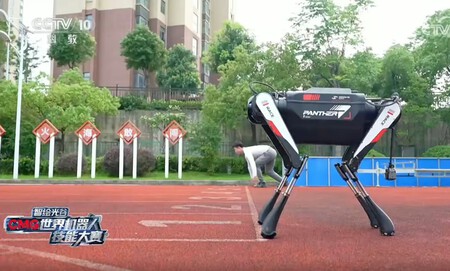
</div>While Black Panther II may not outpace the Cheetah in sheer speed, it clearly surpasses the Wildcat, marking its significance in the evolution of quadrupedal robotics. It stands as one of the fastest quadrupeds ever constructed , although its metrics have yet to be formally recognized.
A New Challenger in Robotics
The title for the fastest 100-meter sprint by a quadrupedal robot is currently held by the Hound robot , developed by the Advanced Institute of Science and Technology of Korea , which completed the distance in 19.87 seconds (around 18 km/h). This benchmark was officially recorded by the Guinness World Records .
</div>The Rise of Mirror Me
Founded in May 2024 in Shanghai by an innovative team of researchers and graduates from the University of Zhejiang , Mirror Me is quickly carving out its reputation in the robotics landscape. Spearheaded by founders Jin Yongbin and Wang Hongtao , both with a significant background in advanced robotics, the startup has rapidly evolved from developing robotic arms and mechanical hands to competing directly with industry giants like Boston Dynamics.
Aside from Black Panther II, Mirror Me is working on new prototypes, with plans for a fast bipedal robot by 2026 and a humanoid robotic personal assistant slated for 2030 .
In summary, as quadrupedal robots like Black Panther II rise to prominence, they showcase the incredible potential of technology to reshape industries and capabilities. With ongoing developments and innovative designs, the world of robotics continues to push boundaries, signaling a fascinating future ahead.