
Innovative Construction Techniques: China’s Giant Inflatable Dome
Anyone who has lived through construction works knows they can be both necessary and incredibly disruptive. Whether it’s a hospital, school, or shopping center, the buildup of dust, noise, and constant traffic of excavators, cranes, and trucks can be overwhelming. China has introduced a remarkable solution to minimize these inconveniences: gigantic inflatable domes that encapsulate ongoing construction sites.
This initiative is more than just a quirky idea; it’s a strategic approach to ensure that construction works have a reduced impact on nearby communities.
What sparked this innovation? China recently embraced a revolutionary idea to lessen the disruption caused by construction works, aiming to encapsulate them literally. This plan involves inflating large “bubbles” that entirely cover the working area, thus significantly minimizing the noise and dust that typically envelop the neighborhoods surrounding construction sites.
The goal is clear: to lessen the impact while operators work inside the protective dome.
From theory to practice. The concept of large inflatable structures isn’t entirely new. Back in the autumn of 1971, Ibiza hosted an ephemeral city created entirely with inflatable designs. What makes China’s current initiative noteworthy is that it’s translating theoretical concepts into practical realities— on a large scale . In Jinan, a populous city in eastern China and the capital of Shandong province, a monumental inflatable dome has been deployed as part of the Honglou 1905 project .
The project aims to establish a large commercial complex but faced challenges due to its location in a bustling district of Licheng , where there are schools, churches, and numerous residential buildings. The obvious question arose: How can construction proceed without disrupting the daily lives of local residents?
An ephemeral ‘cathedral’ of 50 meters. The solution was as ambitious as it was effective. A sizable inflatable dome measuring 150 meters long, 100 meters wide, and 50 meters high was deployed to encase the construction site. This enormous structure spans between 20,000 and 30,000 square meters , providing ample shelter for ongoing work.
The dome is made from a PVDF membrane , a lightweight but durable material, which was installed using a series of fans on June 12. “The outer membrane comprises a network of steel cables that secures the entire structure to the concrete beams below,” explains Wang Luren, project manager for Honglou 1905. Notably, the dome features an open space beneath, enabling unrestricted movement for construction workers.
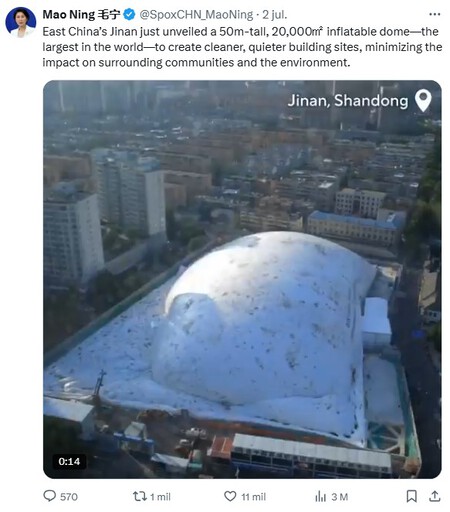
Click on the image to go to Tweet.
Reduction in dust and noise. The project managers assert that this bubble can reduce dust emissions by approximately 90% and dampen construction noise by over 80% . Additionally, it is designed to be water-resistant, making it ideal for ongoing work even during rainy weather. The purpose is to use this dome primarily during the initial phase of construction.
Government officials have already lauded this project. Recently, a spokesman for the Foreign Ministry proudly announced that the inflatable dome in Jinan is “the largest in the world ,” asserting its intent to create clean, quiet construction environments and minimize impacts on surrounding communities.
Worker comfort considerations. While the dome significantly reduces neighborhood disturbances, it raises questions about how workers inside will cope with dust and noise accumulation. Will temperatures rise in the enclosed space? These queries have surfaced, but the project promoters assure that the dome is also worker-friendly.
Avoiding high temperatures. Luren notes that the PVDF membrane blocks 90% of ultraviolet rays , and the structure includes an air exchange system at the top to ensure proper ventilation. “We will also adjust the construction cycle to minimize exposure to high temperatures,” he adds.
Moreover, a spray system and fog cannons will help manage dust levels beneath the dome, keeping them within a “reasonable range.” The entire structure is engineered to withstand storms and snow, effectively maintaining operational efficiency.
In conclusion, China’s inventive use of inflatable domes for construction sites marks a significant advancement in mitigating the adverse impacts of urban development. Not only does this innovative approach prioritize environmental and community well-being, but it also showcases China’s commitment to finding practical solutions that harmonize construction efforts with the daily lives of its residents.