

The Geopolitical War Over Rare Earths: A Spotlight on the Magnet Industry
The United States stands as one of the top military powers globally, leveraging its extensive military infrastructure and advanced technology. However, this military might depends not only on financial investment but also on crucial resources: rare earth elements (REEs). These materials are essential for the production of various military technologies, and there’s a growing realization in the U.S. that turning to alternative suppliers is becoming increasingly difficult, particularly when considering the dominance of China in this sector.
The conflict surrounding rare earths has now morphed into an economic battle centered on magnets, impacting every facet of the U.S. military supply chain. This ranges from the simple components like bullets to the complex technology found in the Lockheed Martin F-35 , the most expensive fighter aircraft in history.
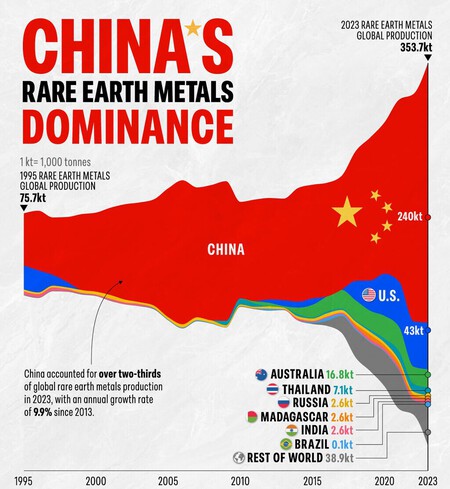
Understanding Rare Earths: It’s crucial to note that “rare earths” is a bit of a misnomer. The term refers to a group of 17 elements that, while not rare in terms of actual availability, are challenging to extract and refine. The process is often damaging to the environment and has been largely relegated to China, which now dominates production.
To illustrate, estimates indicate that China produces approximately 90% of refined rare earths and around 94% of gallium, a critical element for military technologies. Other materials, such as germanium, are also heavily controlled by China, which supplies 83% of global demand. Additionally, the nation plays a key role in aluminum and steel production, further embedding itself into the global supply chain.
The Impact on Weapons Development and Production
Magnets play a pivotal role not just in military applications but in numerous industries, including audio and renewable energy sectors. For the military, magnets are essential in weapons systems, drones, and advanced technologies like night vision goggles. However, the prices of these components have skyrocketed due to supply chain issues.
Soaring Costs and Supply Chain Challenges
According to a recent article in the Wall Street Journal , companies that manufacture components for military drones are facing severe supply shortages, largely due to their dependence on Chinese magnets. This scarcity has forced some manufacturers to delay orders for up to two months. Furthermore, prices for essential materials can be five times higher than the usual market rates, placing significant stress on defense contractors.
The Lockheed Martin F-35: A Case Study
The Lockheed Martin F-35 represents one of the most controversial military projects, not only because of its cost but because of its reliance on rare earth materials. Each fighter is estimated to contain about 400 kg of rare earth magnets, underscoring the dependency of advanced military technology on these elements. Moreover, recent reports revealed that certain materials were exported at prices 60 times their standard values due to restrictions placed by China.
The Broader Impact
Beyond the F-35, the U.S. is also contending with restricted access to other essential elements like gallium and germanium. These materials are crucial for various military applications, from hardened projectiles to sophisticated targeting systems. Following the initiation of trade tensions, China has tightened its grip on these key resources.
A Global Race for Rare Earth Deposits
Countries like the United States, Japan , and members of the European Union are scrambling to secure alternative sources of rare earths. However, while deposits may exist around the world, the processing capabilities to refine these elements into usable components remain limited. A quick fix isn’t forthcoming, even as geopolitical tensions escalate.
The Chinese Factor: Conditioned Sales
Interestingly, companies in the U.S. face barriers not just in accessing the materials but also in the terms laid by Chinese suppliers. For instance, an American drone manufacturer found itself blocked from purchasing rare earth magnets due to requirements related to project documentation and client lists. Such strict conditions highlight how geopolitical issues influence commercial prospects.

The trade war continues to impact the ability of Western nations to procure crucial materials. Such situations illustrate that the ongoing conflict between the U.S. and China revolves not only around economic markets but also extends to the very fabric of military readiness. Without a solution to secure rare earths, the technological prowess of Western nations stands at risk.