
If there is a genre of entertainment that has emerged strongly in recent years, it is certainly True Crime . There are series, podcasts, and even documentaries made with AI about real crimes. Many of these narratives explore the chilling tales of infamous serial killers —notable figures such as Ted Bundy, Jeffrey Dahmer, and John Wayne Gacy have garnered substantial media attention. However, despite their cultural phenomenon status, statistics reveal that the serial killer’s prevalence was largely concentrated within a specific period and primarily in one country: the United States. This begs the question, why is there a scarcity of serial murderers today?
An American Phenomenon
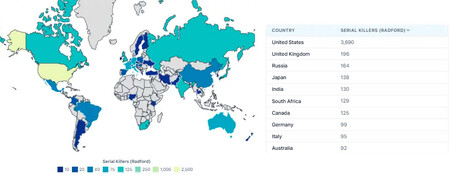
Number of serial murderers per country. Source: Radford University
The FBI defines a serial killer as someone who has killed at least two people on two different occasions . According to the Annual Serial Killers Report and Victims of the University of Radford for 2020, an astonishing 67.7% of registered cases came from the United States. While other countries such as Japan, India, South Africa, Canada, and England have documented cases—some exceeding a hundred —the disparity is stark. In the U.S., there are 3,690 documented cases , dwarfing the combined total of 1,168 cases from other nations.

Why are there more serial murderers in the United States ? One reason is that there are more records and statistics available compared to other countries, suggesting that the actual figures could be biased. The media impact and subsequent glorification of certain killers may also incite others to imitate their behaviors. Furthermore, the ease of geographical mobility within the U.S. has enabled some individuals to commit crimes without being detected.
Three Decades of “Fashion”
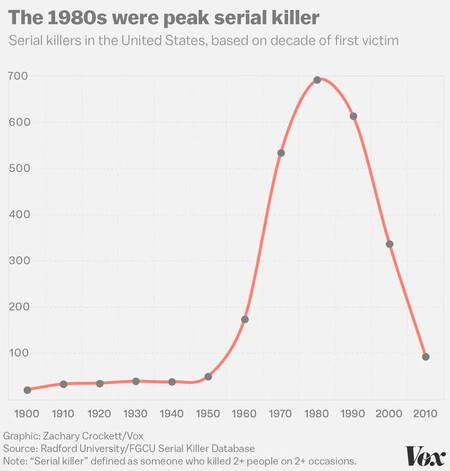
The graph illustrates the surge of serial killings, revealing that most notorious incidents occurred within a three-decade span . Some of the well-known cases, such as those involving Ted Bundy , Jeffrey Dahmer , and David Alan Gore , predominantly fell within this timeframe.
The increase began in the late 1950s , demonstrating a drastic rise during the 1970s , and peaking in the 1980s . Reports suggest that there were 254 active serial killers in the 1980s , with the maximum occurring in 1987 , resulting in over 400 victims . By the 1990s , this figure reduced to 227 , and by 2010 , only 66 cases were recorded.
Why There Are No Serial Murderers
Researchers attribute the decline of serial murderers to multiple factors, especially those related to advancements in criminal investigation . Police databases are now more comprehensive, and communication among various security agencies has improved. This allows for easier identification of patterns in cases and helps in recognizing potential serial profiles.
Moreover, research methods have become increasingly sophisticated. The DNA test , first implemented in the mid-1980s, has become a cornerstone of criminal investigations, although initial techniques were quite rudimentary, leading to prolonged analysis times. The establishment of vast databases only further enhances the efficacy of these investigations.
Technological advancements play a pivotal role as well. The prevalence of security cameras in public and commercial spaces has significantly contributed to resolving numerous crimes across the globe. One notable study indicated that the British Transport Police improved its crime resolution rate from 23% to 48% thanks to the implementation of security camera footage.
Furthermore, Internet searches have proven to be instrumental in cracking cases. For example, Brian Walshe , involved in his wife’s disappearance, made alarming searches on Google about how bodies decompose and ways to dispose of a corpse. This, combined with evidence of his purchases at Home Depot, led to his eventual arrest.
Perhaps the most significant advancement has been in mobile technology. Beyond surveillance images, mobile phone triangulation allows authorities to track both suspects and victims, reconstructing their movements effectively. Mobile data has proven invaluable in high-profile cases like those of Asunta Basterra and Diana Quer .
The decline in serial killers aligns with a general decrease in violence since the 1990s , but it is evident that investigative advancements and technology have made it increasingly difficult for potential serial murderers to operate undetected. In many instances, these individuals often do not commit a second crime due to the enhanced law enforcement capabilities in place.
Cover image | Netflix
In Xataka | A person has made Media Spain hook the most horrendous crimes: Clara Tiscar and ‘Criminopathy’