
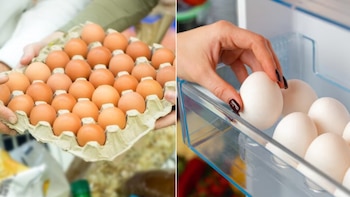
Understanding Egg Storage: Supermarkets vs. Homes
The location of eggs in supermarkets and homes reflects scientific criteria of food security. While they remain at ambient temperature on commercial shelves, they require immediate cooling once they arrive at home. This necessity arises from the constant thermal fluctuations in domestic kitchens, which can compromise the eggs’ natural protection.
Spanish nutritionist María de los Ángeles García, known as “Boticaria García,” explains that the egg shell is not an impermeable barrier. Instead, it contains between seven thousand and seventeen thousand microscopic pores that could serve as entry points for dangerous bacteria like Salmonella. However, nature provides the eggs with a sophisticated defense mechanism: a protective layer called cuticle, which acts like a natural antibacterial varnish, sealing these pores while allowing essential gases such as oxygen, carbon dioxide, and water vapor to pass through.
The Role of Temperature in Egg Safety
The protective cuticle is critically susceptible to sudden temperature changes. When condensation forms on the egg’s surface due to significant thermal contrasts, this defensive layer can dissolve, allowing pathogens to penetrate through the pores of the shell. For this reason, supermarkets keep eggs at constant ambient temperatures, typically around 18 degrees Celsius.
A scientific research study conducted by the Universidad de Chile confirmed this process. Controlled experiments revealed that eggs exposed to temperature variations from 37 °C to 4-8 °C showed external substance penetration in 95% of cases, compared to only 12.5% for eggs kept at a constant temperature. This evidence substantiates that thermal differentials significantly favor the entry of external materials, including harmful bacteria.
The problem worsens when considering the typical journey of eggs from supermarkets to homes. If the eggs were refrigerated in the store and then placed in a car trunk at 30 degrees Celsius, the resulting condensation could compromise their safety before reaching domestic kitchens.

The Challenges of Home Egg Conservation
Household conditions present unique challenges for egg conservation that do not exist in controlled commercial environments. According to García, domestic kitchens experience constant thermal fluctuations due to factors such as cooking activities that generate heat, opening and closing of windows, and variations between day and night.
During cooking, temperatures can rise significantly, while at night, especially in winter, kitchens can experience considerable thermal drops. These variations create an ideal environment for condensation to form on the egg’s surface, progressively degrading the protective cuticle and heightening the risk of bacterial contamination.
Refrigerators resolve this issue by maintaining a thermally stable environment where eggs remain at a constant temperature until preparation. They eliminate fluctuations that could compromise a product’s integrity, thus preserving both safety and nutritional quality.

The specific location of eggs within the refrigerator is equally crucial. Contrary to expectations, the special compartments designed at the doors of many refrigerators are the worst possible place for egg storage. Each time the door is opened, these compartments are exposed to temperature changes that could create the same condensation conditions they are intended to avoid.
Food security experts recommend keeping eggs in interior refrigerator trays where temperatures remain more stable. This location provides optimal protection against thermal fluctuations that could compromise the egg’s natural barrier.
Regulatory Differences Around Egg Storage
The practice of selling eggs at room temperature is not universal. In the USA, egg refrigeration is a mandatory practice from processing to sale and consumption. The United States Food Administration requires eggs to be washed and disinfected before storage at temperatures between 4 and 7 degrees Celsius, a policy designed to prevent salmonella proliferation.
Conversely, the situation in Europe and Latin America differs. In these regions, poultry farmers are obligated to vaccinate chickens against salmonella, reducing the risk that eggs become contaminated from their source.

Microbiological research has revealed important aspects regarding how storage temperature affects pathogenic behavior such as salmonella. Recent studies demonstrated that storage at temperatures higher than 7 °C can significantly increase the virulence of the bacteria present and promote the expression of genes that enhance their pathogenic capacity.
Controlled experiments confirmed that the bacterial load of Salmonella Typhimurium increases considerably in eggs maintained at 25 °C compared to those kept refrigerated. Test subjects exposed to stored egg material at room temperature developed symptoms of salmonellosis by the third day, while those exposed to refrigerated eggs showed no signs of disease throughout the experimental period.
Beyond safety concerns, preservation temperature significantly influences the preservation of the nutritional value of eggs. Refrigeration maintains not just security but also better preservation of high biological value proteins, vitamins B12 and A, selenium, and other essential nutrients that can degrade when exposed to elevated temperatures for prolonged periods.
Refrigerated eggs also maintain higher functional properties in culinary applications. The egg whites better retain their characteristic viscosity and ability to form stable foams, while the yolk preserves its emulsifier properties. These features are particularly important in pastry and other applications where the structural properties of egg proteins are critical for the success of the final product.

Here are some guidelines to ensure egg safety and quality:
- Store eggs in the interior compartments of the refrigerator and within their original container.
- Start cooling immediately after the purchase to ensure maximum protection.
- Do not wash the eggs before saving them since water eliminates the natural cuticle and facilitates the entry of pollutants; washing should be reserved only for the moment before preparation.
- Avoid refrigeration cycles and ambient temperature: Once cold, keep the eggs refrigerated until use.
- Use the “water test” to check freshness: A fresh egg sinks and remains flat at the bottom of the container.
- Do not use the refrigerator door compartments since they suffer thermal variations.
Maintaining eggs at proper temperatures not only preserves their safety but also enhances their nutritional and functional qualities. Understanding the science behind egg storage can help ensure they remain a safe, nutritious, and versatile component of our diets.