
“We will strive to achieve the fundamental modernization of national defense and the Armed Forces by 2035, and to make the popular army a World Class Force in all aspects for the middle of this century.” With these words, Xi Jinping drew in 2017 a military horizon that then sounded ambitious.
This vision could have been dismissed as mere rhetoric, a grandiose gesture designed to impress. However, in China, plans often materialize into significant state projects , with well-defined short-term and medium-term strategies that reach deep into the future. Remarkably, many of these goals have already begun to take shape.
China is not characterized by hurry, yet it advances with a speed that consistently surprises the global community. In 2003, it successfully launched its first Taikonaut into orbit, while the United States and Russia had accumulated half a century of experience in the space race prior. Today, Beijing boasts an advanced orbital infrastructure along with a space program that shows no signs of slowing down.
This trend continues on the mainland as well. In the early 2000s, China had no high-speed trains ; today, it operates the most extensive network on the planet, showcasing an extraordinary transformation. The same is true for its defense capabilities, which is the focal point of this analysis. China has made significant leaps with shipyards capable of constructing large-scale warships , aircraft carriers equipped with electromagnetic catapults, and next-generation combat fighters .
The Emergence of the J-50 Fighter Jet
As reported by Twz, some of the most striking images of a new heavy fighter jet, attributed to Shenyang Aircraft Corporation , have emerged. Known in public conversations as J-XDs and unofficially as J-50 , these images are unverified but align with earlier, less clear photographs and do not display evident signs of manipulation. The design is described as having no tail , a characteristic that analysts expect will define the next generation of combat aircraft.
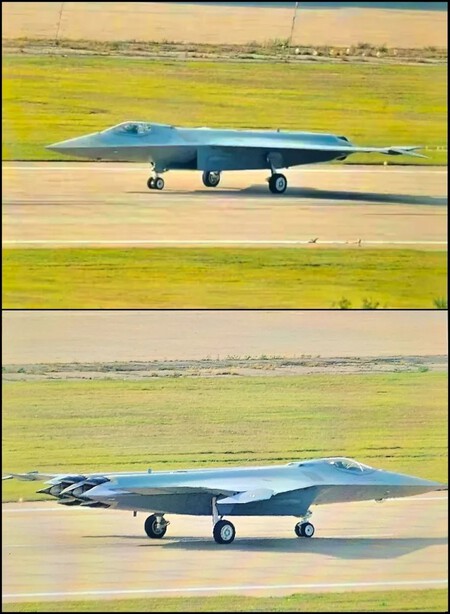
<span>J-50</span>The design features a long, diamond-shaped nose with trapezoidal air intakes that follow a DSI design (Diverterless Supersonic Inlet) scheme. It also boasts a modular electro-optical system fairing beneath the nose, alongside a stream-lined cockpit.
Currently, it remains unclear whether the photographed aircraft is a technological demonstrator or an advanced prototype close to production readiness. Moreover, no confirmed data exist regarding its sensor packages , propulsion systems, or projected timelines. Nevertheless, advancing the J-20 and the Naval J-35 remains a priority for the Chinese military aerospace sector, with the J-50 design indicating a similar trajectory as the J-20.
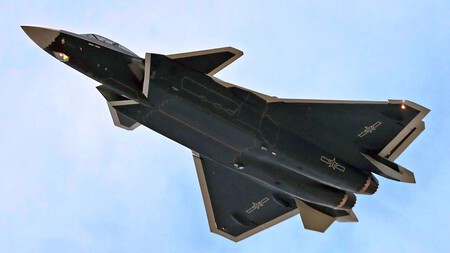
<span>J-20</span>While the recent images offer promising insights, critical questions remain unanswered. It is still unknown what kind of propulsion systems the aircraft will utilize, its sensor configurations, or the nature of the communications and electronic warfare systems it will incorporate.
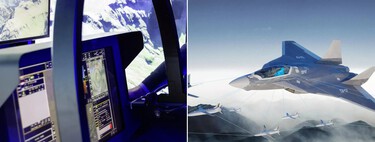
Regardless of the outcomes, the J-50 exemplifies China’s willingness to explore radical concepts in military aviation. With its tail-less design, movable parts, and vector thrusters, this jet is venturing into a frontier that few nations have dared to approach. What remains uncertain is the extent to which this may either represent a unique prototype or a critical component of a long-term developmental strategy. What seems beyond dispute is that China aims to position itself at the forefront of next-generation fighter aircraft.
Images | RUPPRECHTDEINO
In Xataka | The US has a message for those who turned their backs on F-35: now it will fly alone with its own drone army