
The video game industry moves rapidly, often leaving behind its legacy as new consoles and services rise to prominence. Many classic titles remain tethered to aging systems, accounts, and services that may not endure. For enthusiasts who attempt to revisit games from decades ago, the challenge often lies not just in preserving them, but in being able to play them. As the industry evolves, the conversation around the preservation of video games becomes increasingly critical.
Microsoft’s Emulation Initiative
In this context, Microsoft has embarked on an intriguing journey to revive a segment of its gaming history: bringing original Xbox games to Windows 11 without conventional remakes or native PC versions. This initiative is presented as the beginning of a larger preservation effort, though it starts with a limited selection of games. Notably, the technology employed to achieve compatibility with modern hardware is noteworthy.
Initial Game Offerings
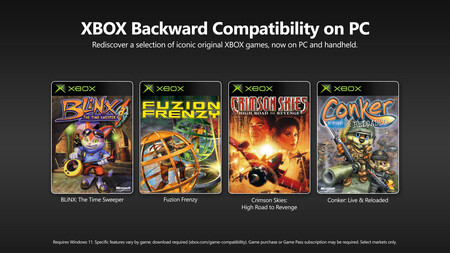
Currently, Microsoft’s program does not encompass the entire Xbox catalog, nor does it enable the execution of every classic game on Windows. The initial offering includes four titles that represent the history of Xbox:
- ‘BLiNX: The Time Sweeper’
- ‘Conker: Live and Reloaded’
- ‘Crimson Skies: High Road to Revenge’
- ‘Fuzion Frenzy’
These games are not traditional remasters; rather, they leverage emulation to replicate the original gaming environment on modern computers. According to Microsoft, this emulation process preserves the essence of the gameplay while also permitting enhancements such as VSync, upscaled resolutions, anisotropic filtering, and improved antialiasing. Gamers also have the flexibility to choose between fullscreen and windowed modes, as well as configure various audio and language settings.
Technical Ease and Accessibility
This initiative extends beyond desktop computers; these titles can also be installed on Windows 11-compatible portable devices, such as ROG Xbox Ally and ROG Xbox Ally X, eliminating the necessity for cloud gaming. The hardware requirements remain modest by today’s standards: 8 GB of RAM and graphics equivalent to a GTX 950 or Radeon RX 550.
Concerns Over Accessibility and Longevity
While this endeavor is commendable, it raises questions regarding long-term access. Microsoft has not introduced standalone installers or DRM-free options, which complicates the preservation narrative. Without clear guidance on whether users will be able to play these games offline long-term, or if they will still be available for download a decade from now, concerns mount.
Access hinges on having Windows 11, the Xbox app, and a license tied to individual accounts. This is a stark contrast to platforms like GOG, which offer users DRM-free backups, thereby allowing offline access.
The Broader Context in Gaming Preservation
This situation unfolds amid a trend where avenues for accessing classic content are dwindling. Nintendo recently shut down digital purchases for the Wii U and 3DS, while Sony announced it would stop producing physical discs for new PlayStation games by 2028. Both decisions highlight a sobering reality: the availability of digital games is inherently linked to the continuity of platforms and the stipulations set forth by their owners.
As Microsoft treads this innovative path, the video game preservation movement stands at a crossroads. The success of these efforts will likely set precedents for how the industry approaches the accessibility and longevity of classic titles in the future.
Images | Xbox