
The Solar Eclipse of 2186: A Celestial Spectacle Awaiting Future Generations
On July 16, 2186, an extraordinary astronomical event is set to unfold as the Moon will align perfectly between the Earth and the Sun, creating a breathtaking total solar eclipse. This event promises a spectacle that will last a remarkable 7 minutes and 29 seconds , eclipsing the current record held since 743 AC by almost two seconds. This record-breaking totality is expected to captivate the imaginations of our descendants, who may wish to witness this phenomenon from locations in Colombia , Venezuela , or Guyana .
This eclipse is unique not only for its length but also because no other eclipse is expected to rival its duration between now and the year 8000 AD. It offers a once-in-a-lifetime opportunity for anyone who might find themselves near the path of totality, making it an event of significant historical and astronomical importance.
The Moon’s Shadow on South America
While the longest duration of the eclipse will occur over the Atlantic Ocean, northern South America is poised to experience extraordinary totalities. Colombia will witness long periods of totality extending from Cali to Puerto Ayacucho , while Venezuela enjoys a similar experience from the Orinoco to Imataca . Guyana , specifically the northern part, including Georgetown , will also be in the optimal zone to witness this extraordinary celestial event.
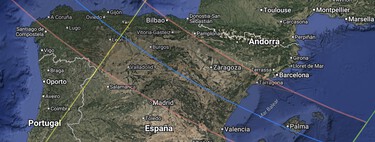
The eclipse will not be limited solely to these countries, as virtually all of South America, including the entirety of Brazil , will observe a partial eclipse. Furthermore, it will be partially visible across a wide swath from Mexico to Paraguay and even parts of West Africa . In Spain , only the Canary Islands will fall under the eclipse’s shadow, albeit in a diminished capacity at sunset.
Understanding the Duration: The “Perfect Storm” of Eclipses
The extraordinary duration of this total solar eclipse is attributed to a rare “ perfect storm ” in the celestial positioning of the Earth, Moon, and Sun. On this day, the Earth will be at its aphelium , the point in its orbit farthest from the Sun, which will cause the solar disk to appear slightly smaller. Meanwhile, the Moon will be at its perigee , its closest point to Earth, resulting in a larger apparent size to obscure the Sun. The trajectory of the eclipse will also pass remarkably close to the Equator , maximizing the duration of totality as the Moon’s shadow sweeps across the Earth.
Predictive Science: How We Know
The accuracy of eclipse predictions is a testament to the advancements in computational astronomy . Scientists are able to pinpoint the positions and velocities of the Earth and Moon and then apply Newton’s Laws of Motion to forecast eclipses over centuries. Their sophisticated algorithms integrate gravitational equations, enabling precise projections with surprisingly small margins of error—often less than a minute over vast time spans.
A Legacy Link: The Saros Cycle
The total solar eclipse of 2186 belongs to the same cycle, known as Saros 139 , which is a series of eclipses occurring roughly every 18 years, 11 days, and 8 hours. This cycle ensures a remarkable consistency in celestial geometry, allowing scientists and enthusiasts to predict not only the occurrence of eclipses but also their magnitudes and durations.
As discussions among eclipse enthusiasts emerge, visions of cruise ships and hypersonic flights chasing the shadow of the Moon to maximize the experience are already taking shape. Such imaginative proposals highlight a vibrant community eager to explore and celebrate the wonders of the universe.
While we may only speculate about the reality of witnessing this eclipse, it serves as a fascinating reminder of how science gives us the ability to transcend time and appreciate the cosmic wonders awaiting future generations.