
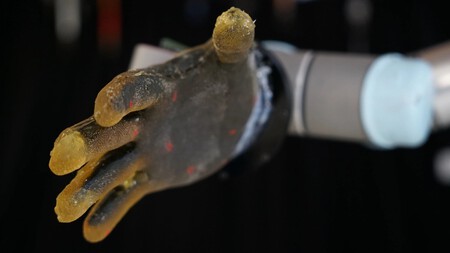
Can a robotic hand like Optimus or 1x feel like ours? Researchers at the University of Cambridge and University College London believe they have taken an important step in that direction. They have developed an artificial skin composed of a single flexible material, capable of detecting temperature, pressure, cuts, and multiple simultaneous touches. All without rigid layers or sensors distributed inside. The most promising aspect, according to its creators, is that it can adapt to complex forms and promises a relatively simple manufacturing process: it is enough to melt it, pour it into a silicone mold, remove the internal positive, and place it as a glove on a robotic structure, as shown in this demonstrative video.
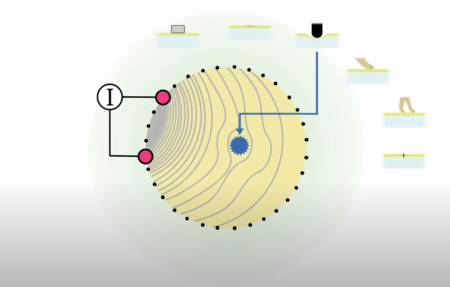
The nucleus of this technology is a driver hydrogel that, when combined with electric impedance (EIT) tomography, allows continuous registration of what happens on its surface. When a stimulus occurs—such as contraction, heat, or pressure—the electric fields are altered. The system detects not only the type of stimulus but also its location and environmental conditions. All this information is interpreted through automatic learning , with latencies that depend on the number of active channels, as explained in an article published in Science Robotics.
A Soft Membrane, Millions of Data
The best example of the system is a robotic hand of real size, hollow inside, fully covered with this artificial skin. Instead of distributed sensors, it uses exclusively 32 electrodes placed on the wrist. This configuration allows it to extract more than 1.7 million information channels , derived from 863,040 different combinations.
During tests, the hand was exposed to various stimuli: a human finger, a thermal probe, and the impact of a scalpel. In all cases, it was able to distinguish the type of interaction and locate it with an average precision of about 25 millimeters across its entire surface. The interesting thing is that a sensor is not necessary for each type of stimulus. The membrane itself reacts differently depending on the intensity or nature of the contact, and it is the model that identifies the most relevant signals among hundreds of thousands of possibilities.
</div>In addition to touch, this skin can actively monitor the environment. During a 100-hour test , the system registered variations between 19 and 25 °C and 38 to 72% relative humidity , as detailed in the official note of the University of Cambridge. This design, free of rigid components, facilitates its integration into prosthetics, technical clothing, control surfaces , or collaborative robots . Applications could range from rehabilitation and remote exploration to the automobile sector.
</div>This development does not start from zero. In recent years, we have seen several proposals aimed at endowing sensitivity to robots, such as synthetic skins capable of replicating pain, or those that closely resemble human skin or are capable of self-refilling and recycling. What distinguishes the work of Cambridge and UCL is its radically simplified approach: a single flexible layer without mechanical components, which centralizes all sensitivity and interprets it through software.
<img alt="Japan has the key to the next evolution of robots: wrapping them with human skin" width="375" height="142" src="https://i.blogs.es/72cde2/sei_210194545-2-/375_142.jpeg"/>Challenges remain ahead: improving the resolution in areas far from the electrodes and reinforcing the resistance of the long-term hydrogel. However, a paradigm shift seems to be underway. Everything indicates that it is only a matter of time before we see robots not just more advanced in mobility and interaction but also closer to us in appearance and physical sensitivity. An artificial skin like this opens the door to a new generation of machines that can execute tasks while also being aware of their surrounding environment. Yet, we are still far from achieving the level of realism proposed by ‘Detroit: Become Human.’
Images | Cambridge University (1, 2, 3) | Quantic Dream