
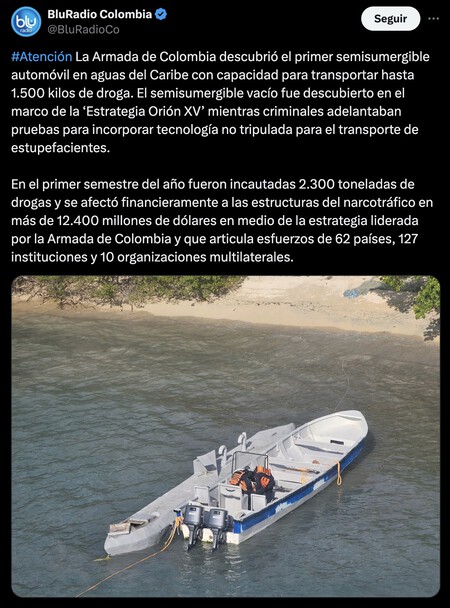
The Rise of Narcosubmarinos: A New Era in Drug Trafficking Technology
The drug trafficking industry faces a formidable challenge that extends beyond the mere production of drugs; it revolves around the distribution of these substances. Traditional networks, which often employ commercial vehicles or utilize ‘mules‘, have now evolved. Drug traffickers have started operating advanced fleets of submarines . These artisanal vessels, known as narcosubmarinos , have recently gained a technological edge, making them increasingly sophisticated and challenging to intercept.
Recently, authorities apprehended a crewless narcosubmarino controlled remotely via Starlink , the satellite internet service developed by Elon Musk. This latest development presents a significant headache for *maritime authorities*, as the technology involved offers traffickers innovative tools for evading detection .
In early April, Colombia’s Navy reported the discovery of a narcosubmarino tethered to another vessel, boasting the capacity to transport tons of narcotics . What caught the attention of the authorities was not just its size or capacity but the Starlink antenna it carried, representing a new frontier in drug trafficking technology.
The presence of the Starlink antenna indicates the likelihood that the narcosubmarino could be operated semi-autonomously . With no crew onboard, traffickers could control its operations from the shore, potentially leading to a significant advantage for them in the face of interception. The absence of human operators means that, while authorities might seize the vessel, the individuals responsible for the shipment could remain at large.
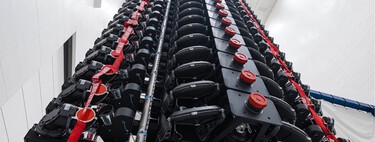
This capability grants traffickers a logistical advantage , as it allows them to navigate various water bodies imperceptively, aided by a global satellite connection. The technology poses a serious challenge for anti-drug forces, further complicating their efforts to track and intercept narcosubmarinos. Although narcosubmarinos are often not true submarines but semi-submersibles , the absence of crew means they can evade radar detection more effectively.
In addition to the Starlink system, this specific narcosubmarino is equipped with two cameras—one internal to monitor its engine and transmission, and another external to facilitate navigation and obstacle avoidance. Such advancements in technology signify a shift in the methods employed by drug traffickers.
The Colombian Navy’s seizure of a remote-controlled narcosubmarino underscores the adaptability of criminal organizations in leveraging modern technology to enhance efficiency. Although the recent vessel was found empty and is believed to have been a proof-of-concept unit, its existence hints at the likely proliferation of such sophisticated vessels, with authorities expecting more to follow.
Statistics reveal a noteworthy trend. In 2009, roughly eight such vessels were identified, a figure that reportedly skyrocketed to around 180 by 2020 . While the actual number may vary, it underscores a significant investment in the construction and improvement of these advanced drug trafficking vehicles.
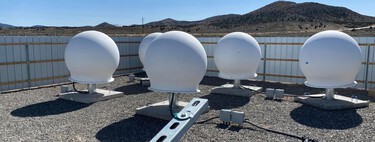
Many narcosubmarinos are poorly constructed vessels with limited lifespans, but some have evolved into more sophisticated designs, resembling the submarines used by global military forces. In fact, in a recent interception, Colombia’s Navy targeted a vessel aimed at Australian shores , demonstrating the extensive reach of Colombian drug trafficking networks.
It is clear that this advancement represents a significant leap in traffickers’ capabilities compared to earlier models from the 90s. A narcosubmarino equipped with Starlink indicates that traffickers are preparing for a new era—one marked by the potential for remote operations in areas lacking traditional coverage, fundamentally altering the landscape of drug trafficking.
As authorities face this evolving challenge, they must adapt to the advanced tactics employed by traffickers. The implications are daunting, suggesting that the fight against drug trafficking will require a rethink of strategies and resources to keep pace with the innovations coming from the underworld.