
## Voyager 1: A Mission Beyond Imagination
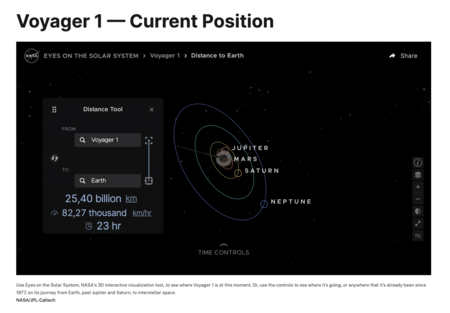
At an astonishing distance of 25,000 million kilometers from Earth, Voyager 1 continues to transmit data from the uncharted territories of interstellar space. Launched in 1977, this remarkable probe remains operational nearly half a century later but is facing an increasingly delicate situation. To extend its lifespan, NASA’s mission team is making the difficult choice to power down certain instruments. Recently, this strategy became evident during a significant maneuver involving one of its scientific instruments.
### The Maneuver
On April 17, engineers at the Jet Propulsion Laboratory in Southern California officially sent the command to shut down the Low-Energy Charged Particles (LECP) experiment. This instrument plays a crucial role in measuring low-energy charged particles—such as ions, electrons, and cosmic rays—originating from both our solar system and the broader galaxy. This shutdown, however, was not a snap decision; it was part of a pre-defined roadmap devised years ago by both scientific and engineering teams, aimed at reducing power consumption while ensuring the mission’s longevity.
### The Power Source Dilemma
To comprehend why NASA is resorting to such measures, it’s essential to note how Voyager 1 is powered. Unlike many modern spacecraft that utilize solar panels, Voyager 1 operates on a radioisotope thermoelectric generator. This device converts heat from plutonium decay into electricity. While this technology has sustained the mission for decades, it has its limitations. Both Voyager 1 and its twin, Voyager 2, lose approximately 4 watts of power each year—a gradual decline that, when managed meticulously over decades, can have substantial implications.
### A Sudden Power Drop
Compounding the situation, a recent unexpected drop in Voyager 1’s power levels occurred during a routine maneuver on February 27. NASA explained that any further decline could trigger the spacecraft’s undervoltage protection system, a built-in safety feature designed to automatically disconnect components to safeguard the probe’s functionality. This incident prompted the team to proceed with greater caution, accelerating the decision to shut down the LECP.
### Pruning for Longevity
The decision to turn off the LECP instrument is part of a broader strategy, sometimes referred to as “pruning.” The shutdown was premeditated, stemming from discussions among those responsible for the mission’s scientific elements and the operational team. Of the ten instruments aboard Voyager 1, seven have already been powered down. Notably, the LECP will not be entirely inactive; a small motor that allows the instrument to rotate for scanning will remain operational, consuming a mere 0.5 watts. This decision keeps the option open for potential future reactivation.
### Future Plans
NASA views the shutdown not as an end but as a temporary measure that allows time for a more comprehensive energy management plan. According to the agency, the shutdown of the LECP is expected to provide Voyager 1 with an additional year of operational life. During this time, engineers are preparing to implement an ambitious strategy dubbed “Big Bang,” which aims to modify several energy-hungry devices simultaneously—some will be turned off while others will be replaced with more efficient alternatives. The goal is to conserve the necessary heat to keep essential scientific instruments functional for as long as possible.
### Timeline for Implementation
The first tests of this new energy management approach will be conducted on Voyager 2, which is slightly closer to Earth and has more power available. Scheduled for May and June 2026, these tests will determine the best path forward. If all goes well, the same energy-saving measures could be applied to Voyager 1 as early as July.
In summary, the story of Voyager 1 is one of human ingenuity and resilience, demonstrating our commitment to extending the boundaries of exploration even as its resources dwindle. Every decision made now will help ensure that this iconic spacecraft continues to enrich our understanding of the universe for years to come.