
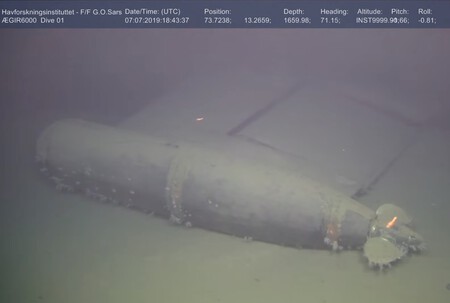
The Komsomolets: A Sunken Giant in the Norwegian Sea
Almost 1,700 meters beneath the Norwegian Sea lies much more than a mere shipwreck. Inside the Komsomolets, the remnants of a once-powerful Soviet submarine, rests a nuclear reactor and two torpedoes armed with nuclear warheads. These artifacts are now locked within a decaying wreck, subjected to decades of salt water, immense pressure, and corrosion. This tragic sinkage wasn’t the result of a clandestine mission but rather a catastrophic accident that transformed a monumental engineering feat into an environmental concern still being unraveled today.
The Aftermath of Disaster
The saga of the Komsomolets didn’t conclude when it reached the ocean floor. Research indicates that the reactor continues to release radionuclides sporadically, a phenomenon that has been examined with greater precision compared to the earlier studies of the 1990s. Fortunately, these emissions have yet to significantly impact the marine ecosystem, but uncertainties linger.
A Submarine Ahead of Its Time
Before becoming flotsam, the Komsomolets was among the most ambitious projects of Soviet naval engineering. Launched in 1983, it featured a robust titanium hull and was capable of operating at more than 1,000 meters deep—an exceptional feat for military submarines of its era. According to historical analyses by the BBC, NATO had anticipated that this model would signal the dawn of a new class of attack submarines, but the Soviet Union never constructed a second unit.
The Fateful Day: An Accident That Changed Everything
On April 7, 1989, a fire broke out in one of the Komsomolets’ compartments while navigating the Norwegian Sea. While the crew managed to surface the submarine, the flames quickly spread and crippled several systems. After five harrowing hours, the Komsomolets sank with a tragic toll of 42 out of 69 crew members perishing.
Understanding the Risks
The wreck holds materials that could tempt the imagination towards the notion of a nuclear explosion; however, contemporary assessments do not categorize spontaneous detonation as a significant threat. Such an explosion requires specific operational mechanisms to be synchronized precisely. The real concern lies in the potential for corrosion to eventually allow radioactive materials to escape the reactor or, worse, the warheads.
Containment and Monitoring Efforts
The initial strategy did not involve refloating the submarine but rather isolating its most critical areas. A Russian expedition in 1994 deployed manned submersibles to seal six torpedo tubes and critical openings in the forward section using titanium plates. This containment strategy aimed to minimize water circulation within compartments housing the warheads, effectively staving off potential plutonium release. This measure reportedly showed signs of remaining intact during a 2019 inspection.
Recent Discoveries
Fast forward to 2019, researchers mounted a different kind of expedition to the wreck, using the remotely operated vehicle Ægir 6000. This high-tech apparatus was armed with cameras, manipulative arms, and sampling instruments to examine the wreck without risking human life. The findings demonstrated that the assemblies containing nuclear fuel were indeed compromised, with seawater infiltrating the reactor material.
The Path Forward: Monitoring Instead of Intervening
Despite the potential hazards, reaching the Komsomolets is no longer deemed impossible. Submersibles have shown that work can be conducted at such depths. However, determining what methods would improve the situation without risking additional complications remains a significant challenge. Presently, the Norwegian nuclear safety authority reports no plans to carry out further containment operations. Instead, the focus remains on ongoing measurement and monitoring of a wreck that has been submerged for nearly four decades.
Images and further reading can be found through the Norwegian Marine Research Institute.