
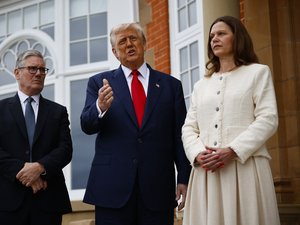
On July 14, 2025 , former U.S. President Donald Trump issued a bold ultimatum to Russian President Vladimir Putin , demanding an immediate cessation of hostilities in Ukraine within a timeline of 50 days. However, as tensions escalated, Trump recalibrated his stance, announcing on July 28, 2025 , a drastic reduction of that timeline to a mere 10 to 12 days . This announcement underscores not only the urgency of the situation but also Trump’s assertive approach towards foreign diplomacy and intervention.
While addressing a gathering in Turnberry, Scotland , Trump expressed his disappointment with Putin’s apparent lack of progress towards ending the conflict. “I have set a new deadline of around 10 or 12 days from today . There is simply no reason to wait any longer,” Trump stated. His frustration reflects broader concerns internationally about the ongoing conflict, with the repercussions of continued hostilities felt across various regions.
Kyiv’s Response: A Show of Appreciation
Trump’s announcement resonated positively in Kyiv , where Ukrainian officials expressed their gratitude for the former President’s decisive stance. Andriy Yermak , the head of the Ukrainian presidential administration, took to social media platform X to thank Trump for showing “firmness” and delivering a “clear message of peace through strength.” Yermak’s tweet reflected a notable sentiment within Ukraine, emphasizing the belief that Putin only respects power and that Trump’s approach sends a strong signal.
Echoing Yermak’s sentiments, Trump’s assertive language has garnered a sense of hope among Ukrainian leadership and citizens alike. Yermak acknowledged the urgency of the situation, stating, “Putin respects only power—and that message is loud and clear.” This resonates deeply in a region where diplomatic negotiations often falter under pressure.
The Broader Implications of Trump’s Ultimatum
The move to shorten the ultimatum has significant geopolitical implications . Trump’s return to the international stage, even in the capacity of a former president, raises questions about U.S. foreign policy direction and the role of emerging global actors in conflict resolution. Trump’s unapologetic stance suggests a pivot away from more traditional diplomatic tactics that have characterized U.S. engagement over the past few decades. It indicates a robust, action-oriented approach, resonating with his supporters and those advocating for a tough stance against aggressors.
However, experts warn that Trump’s strategy may escalate tensions further rather than encouraging dialogue. Critics argue that such ultimatums may deter constructive engagement, forcing Russia deeper into a corner—where options become limited, and the potential for miscalculation rampant. The cyclical nature of conflict resolution and escalation often implies that actions rooted in forceful diplomacy can have unintended consequences.
Potential Sanctions and Future Actions
The proposed harsh sanctions by the U.S. loom large over Russia, with economic and political ramifications poised to unfold swiftly if hostilities do not cease. Such sanctions historically aim to pressure governments into compliance, but as we’ve witnessed in previous conflicts, their effectiveness can vary greatly. Trump, while promising heavy penalties, may need to consider the implications for American allies and global markets.
Russia’s response to these escalating threats remains to be seen. Historically, Russian leadership has positioned itself against Western sanctions, often leveraging its own economic resources and alliances to counteract effects. The coming weeks will be pivotal as Trump’s new deadline approaches, potentially impacting the internal dynamics within Russia.
As the clock ticks down on Trump’s looming ultimatum, the unfolding drama serves as a poignant reminder of the fragile state of global relations. The world watches closely as leaders navigate a path fraught with peril but driven by the hope for peace and resolution.
In summary, Trump’s renewed ultimatum significantly alters the narrative surrounding the Ukraine-Russia conflict. His call for immediate action evokes a range of responses domestically and internationally. The effectiveness of this approach remains uncertain, but its implications for future diplomatic engagements are profound. The next few weeks will undoubtedly shape the course of this conflict and potentially redefine U.S. foreign policy under a returning Trump administration.