
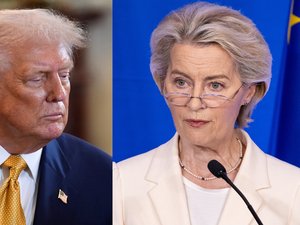
Ursula von der Leyen, president of the European Commission, and Donald Trump, President of the United States, recently announced a significant agreement on customs duties on July 27, 2025. This development raises crucial questions about its impact on Europe and the broader global economy . Economist Stéphanie Villers from PwC France lends her insights to help clarify the implications of this agreement.
What to remember
- The agreement imposes a 15% customs tax on all European goods, up from the previous 10%. Certain sectors already faced penalties as high as 25%.
- For France , this increase signifies a competitiveness shock (approximately 25% on final prices), yet it remains manageable given that exports to the U.S. are relatively modest compared to the intra-European market.
- Critics argue that the agreement is unbalanced, particularly as it overlooks the dominance of services provided by GAFAM (Google, Apple, Facebook, Amazon, Microsoft). Brussels, especially Ursula von der Leyen, has faced accusations of favoring German interests at the cost of European unity.
What does the commercial agreement signed this Sunday between the EU and the USA entail?
The recent agreement mandates a 15% tax on all European goods exported to the United States. While some exceptions may exist, their specifics remain unclear. Historically, European products faced a tax of only 10%, with certain sectors, including automobiles and aerospace, subjected to a 25% tariff. For France, this shift is significant; however, it’s essential to view it in context. France’s export profile primarily includes wines , spirits , pharmaceuticals , and cosmetics . Before Trump’s presidency, customs duties were below 2%, but they now leap to 15%. As a result, the costs of French products in the American marketplace are likely to rise, compounded by the depreciation of the dollar. Despite the steep increase to 25% on some goods, it’s important to remember that France exports seven times more goods within the European Union than to the U.S. Thus, while unfavorable for the French economy, this rise is somewhat absorbable.
“The exchange was not loyal”
Are we justified in feeling disappointment regarding the direction of this exchange?
Many experts argue that the exchange process lacked fairness. Donald Trump consistently sidesteps discussions on services, even though the GAFAM companies have an enormous influence on the European economy. The agreement fails to consider both exported goods and the taxed services. Economically, the European Union is a formidable power; it could have negotiated from a place of strength. Ursula von der Leyen’s defense of what many perceive as German interests raises questions about European unity. There’s a prevailing sentiment that the agreement favors German exports to the U.S., which is disheartening for France. While it won’t destabilize the economy, it signifies a missed opportunity to showcase a united front among the 27 member nations against the U.S. This agreement stands as a landmark moment for the advancement of European interests and the cultivation of a European spirit.
In this context, are American consumers the ultimate losers?
Yes, American consumers will likely bear the brunt of rising prices as products become more expensive due to the new duties. In the medium term, it will be interesting to observe how American citizens react to these changes, especially since Trump campaigned on a platform of combating inflation , which appears contradictory to the new trade measures. The outcome of this agreement could reshape economic dynamics not only between the U.S. and Europe but also within the U.S. itself.
The announcement of new customs duties between the EU and the U.S. reflects a complex landscape of international trade relations, showcasing the ongoing tension and negotiation required to balance national interests while striving for a cohesive European identity. The ramifications of this agreement extend beyond immediate economic effects; they pose critical questions about the future of transatlantic relations and the unity of the European Union in an increasingly competitive global market. Understanding and responding to these dynamics will be crucial as Europe seeks to navigate the challenges ahead while fostering growth and resilience in its economy.