
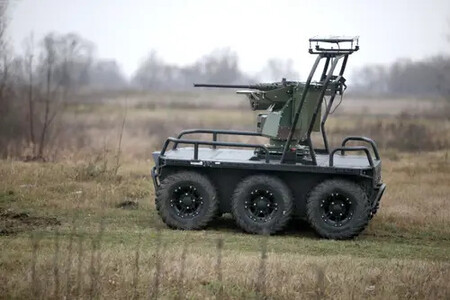
The British inventor Ernest Swinton first proposed using “land ships” to cross trenches and avoid sending infantry directly into fire. That idea gave rise to the first modern tank a year later. Now, more than a century later, the logic is the same again: find a machine that can go where a soldier no longer can.
A Front Too Deadly
The war in Ukraine has escalated to a stage where deploying troops to the front lines is becoming prohibitively dangerous. The saturation of drones has turned large areas of the battlefront into deadly zones where any movement is rapidly detected and punished. This situation has fundamentally reshaped military strategy; it’s not merely about more armor or artillery but rather about sustaining offensive capabilities without risking human life. As Ukrainian forces confront this grim reality, the notion of reassessing human deployment becomes imperative. If the front devours soldiers, couldn’t machines take their place?
The Birth of a New “Frankenstein”
The adaptation of warfare styles has led Ukraine to explore a radical approach: converting weapon systems initially designed for fixed positions into mobile ground robots. Companies such as Frontline Robotics have repurposed their turret-autonomous systems like the Buria into armed unmanned vehicles that function as micro-tanks. While they may not be traditional tanks, they effectively fulfill many of the same roles: moving, shooting, taking cover, and attacking independently of human control.
The War Against Russian Infiltrations
The immediate goal of these robotic units is not large-scale offensives but rather targeting small groups of Russian infiltrators. Moscow has employed effective tactics involving small infantry teams that slip through detection systems, infiltrating Ukrainian defenses. Recognizing that sending more infantry only exacerbates casualties, Ukraine now deploys armed robots controlled from extensive distances to intercept and neutralize these threats.
The Classic Tank Is Getting Old
There’s a compelling rationale behind this shift: traditional tanks are vulnerable. Both sides in this conflict have learned that expensive armored vehicles can be easily destroyed by low-cost drones. The economic balance has been disrupted, making armed ground robots a logical solution. They are cheaper, quicker to produce, and if they’re destroyed, there’s no human loss—a significant advantage in a conflict marked by heavy casualties.
Evolution at the Speed of War
Remarkably, this adaptation is happening at an unprecedented pace. Frontline Robotics claims they roll out updates as frequently as twenty times a month and major revisions every six months. The battlefield has become a real-time laboratory, allowing for instantaneous feedback from soldiers, which in turn drives rapid innovations in robotics. This dynamic represents a stark contrast to the slower bureaucratic processes often found in Western military industries.
Defend Without Humans
The use of ground robots is not merely a tactical evolution; it’s changing the fundamental approach to combat. Ukraine has deployed these technologies for various missions, including evacuating the wounded and clearing paths, totaling over 50,000 missions in just one year. They have successfully captured Russian positions using aerial drones and ground robots without putting infantry at risk, presenting a future where entire combat zones may be defended and assaulted by unmanned systems.
The Ground War Is Mutating
What Ukraine is doing with these robotic tanks may appear makeshift, but it signifies a significant transformation in warfare. For centuries, military success often relied on the deployment of human soldiers into danger. Now, machines are stepping in as sacrificial entities, fundamentally shifting how ground warfare operates. In a theater where every inch won costs lives, preservation becomes the priority, marking a new era where the human element is increasingly distant from the frontline.
Image | Frontline Robotics, Oleksandr Klymenko/Ukrinform