
Understanding the Spiraling Costs of Lithium Batteries
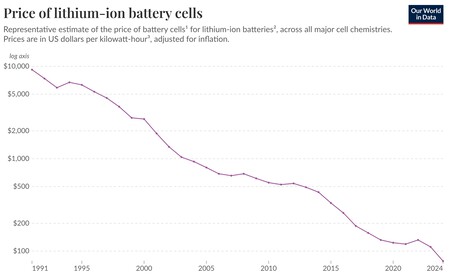
The world is undergoing significant transformations as it strides toward greener energy solutions, with lithium batteries playing a pivotal role. These batteries not only serve as the backbone of electric vehicles (EVs) but also effectively store energy generated from renewable sources like wind and solar. Notably, in the past 35 years, the price of lithium batteries has seen a staggering 99% decrease.
From $9,210 to $111 per kWh: A Game-Changing Decline
In 1991, the cost of a lithium-ion battery stood at an eye-watering $9,210 per kilowatt-hour (kWh), adjusted to constant 2024 dollars. Fast forward to 2023, and that number has plummeted to just $111 per kWh. This remarkable decline underlines the rapid advancements in battery technology and production efficiency.
Real-World Implications
Further illustrating this trend, experts from Our World in Data highlighted that the battery for a standard electric vehicle—capable of a range of 350 to 400 kilometers—costs approximately $5,000 today. In contrast, just a decade ago, a similar unit would have been priced over $20,000, and way back in 1991, around $600,000. What’s more, recent developments indicate that we have recently crossed a crucial threshold: $100 per kWh, a pivotal point historically regarded as the marker for cost parity with conventional internal combustion vehicles.
Charting the Future: Price Trends and Global Production
Analyzing the price trends for lithium-ion batteries through graphs reveals a continuous and steep decline from 1991 to 2024, indicating that prices are expected to stabilize around $50-$60 per kWh by 2024.
The second graph correlates prices with cumulative global production. Starting with just 130 kWh installed in 1991, production soared to 3,510 GWh by 2023. This sustained linear trend across multiple decades suggests that the price drop isn’t coincidental but rather a stable mathematical principle, essential for predicting future pricing trajectories.
The Wright’s Law Effect
According to Wright’s Law, battery prices decrease by approximately 19% every time global cumulative production doubles. This learning rate has proven consistent for over 30 years, irrespective of economic downturns, supply chain issues, or even global pandemics. The incredible growth—27 million times more capacity in three decades—is a testament to the efficacy of this law.
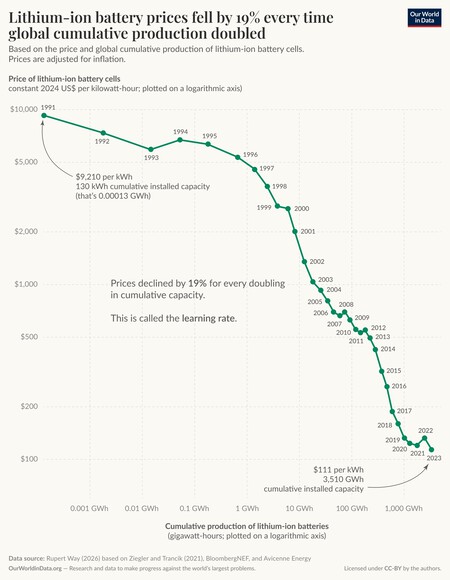
Every time global cumulative production doubles, battery prices have fallen by 19%. Our World in Data
The Road Ahead: Forecasting the Future
These trends are not merely reflective of past achievements; they serve as credible forecasts for the industry. A stable learning rate allows stakeholders to make informed decisions about future investments and technological advancements in battery storage. According to the International Renewable Energy Agency (IRENA), solar power, too, has experienced a significant cost reduction of 90% from 2010 to 2023, exemplifying the trend of decreasing renewable energy costs.
European Implications and Storage Needs
The falling threshold below $100/kWh has substantial ramifications. The European Commission projects a future need of between 200 and 600 GWh of storage by 2030, signaling that Europe is positioned to face the financial responsibilities associated with its energy transition.
Limitations and Challenges Faced by the Industry
While these graphs effectively convey the average costs of different lithium-ion battery types, they omit the nuances of various profiles, including energy density and lifecycle. Additionally, the associated costs of installation and replacement must also be considered. Structural risks related to the supply chain, specifically for critical minerals like lithium, cobalt, and nickel, remain a concern, as geopolitical tensions could disrupt future advancements.