
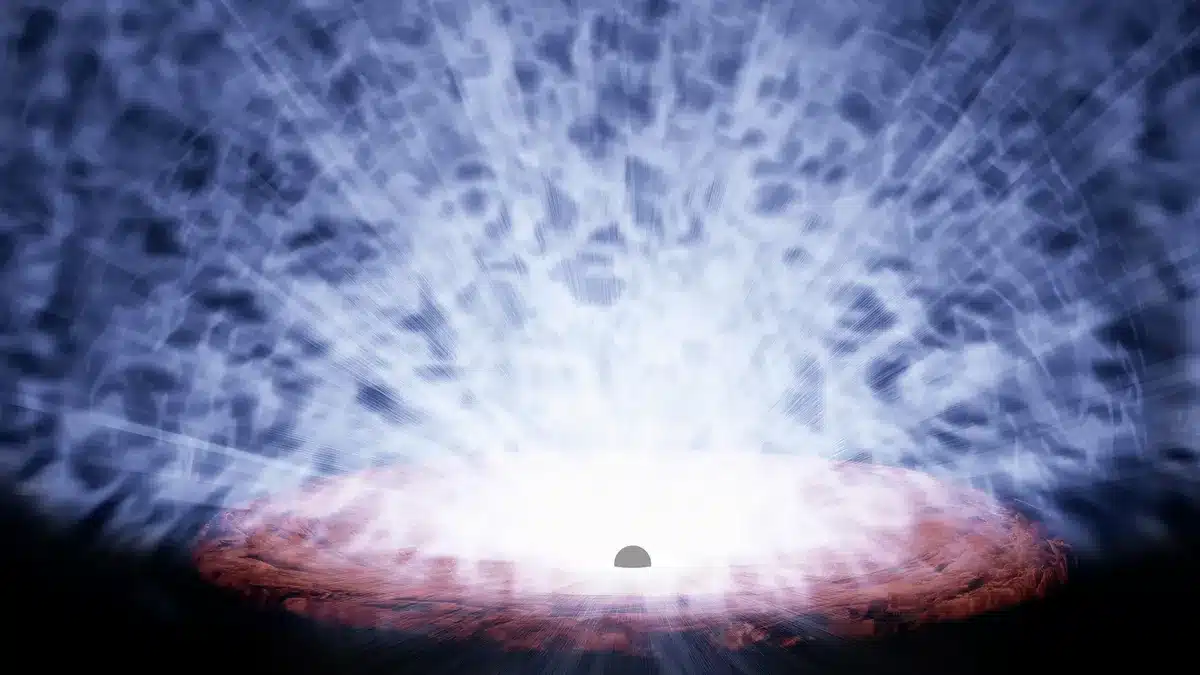
In the depths of the Universe, a cosmic monster is losing control. The quasar PDS 456, a supermassive black hole located 2.5 billion light-years away from Earth, has become the stage for an extraordinarily violent phenomenon: bursts of superheated gas are being expelled at speeds close to that of light. Thanks to the XRISM space observatory, operated by the Japan Aerospace Exploration Agency (JAXA), astronomers have finally been able to observe this galactic storm in detail—revealing discoveries that surpass their wildest expectations.
Uncontrolled Quasar
A quasar is one of the most luminous objects in the universe . It is a supermassive black hole that actively devours matter, generating colossal amounts of energy . When a sufficient amount of gas, dust, or even stars approaches its event horizon, this material heats up to extreme temperatures, producing light capable of eclipsing entire galaxies.
PDS 456 is a giant, weighing in at 1.5 billion solar masses. Located relatively “close” on a cosmic scale, it has been studied for years. However, the XRISM (X-ray Imaging and Spectroscopy Mission) has recently shed light on a particularly strange aspect of its behavior.
Super-Fast Winds… in “Chunks”
Researchers have identified ultra-fast plasma winds within this quasar—jets of ionized gas expelled at astonishing speeds: 20 to 30% of the speed of light. What surprised them the most is the structure of these winds. Contrary to previous assumptions, they are not diffuse or homogeneous. They are fragmented, clumped into actual “bullets” of plasma shot out at very high speeds.
Upon analyzing the data, published in Nature, the team distinguished five different types of gas, each with its own velocity. This complexity, never before observed at this scale, allows for a reconstruction of a phenomenon akin to bursts fired from a cosmic cannon.
And this is no mere firework display: each year, PDS 456 ejects enough material to form between 60 and 300 stars similar to our Sun. This material does not escape randomly—it comes from the nearest 0.1 light-years of the black hole. This makes PDS 456 a unique laboratory for observing the interactions between black holes and galaxies.
Impact on Galactic Evolution?
These winds are not just an impressive spectacle: they are at the core of what astrophysicists call the “feedback” from black holes. By expelling vast amounts of material and energy, a quasar can influence the evolution of its host galaxy, potentially hindering the formation of new stars by pushing away the necessary gas for their birth.
However, the precise mechanism behind this feedback has remained vague until now. Thanks to XRISM, scientists can now map these ejections with unprecedented accuracy, which could also illuminate the connections between the activity of a black hole and the growth (or decline) of its galaxy.
Is PDS 456 Unique?
For now, PDS 456 remains a standout case. The research team is working to observe other similar quasars to determine whether these “bullets” of ultra-fast plasma are a common characteristic or if this quasar is a cosmic exception.
As explained by researcher Valentina Braito from the National Institute of Astrophysics in Milan:
“PDS 456 is a valuable laboratory for studying the powerful winds produced by supermassive black holes in the local universe. This new observation has enabled us to measure the geometry and velocity distribution of the wind with a level of detail previously unimaginable before the advent of XRISM.”
More Extreme Universe
As our instruments gain precision, the Universe reveals increasingly extreme phenomena. PDS 456 serves as a reminder that even black holes, symbols of absorption and silence, can explode with violence and light—a fascinating and possibly critical component in understanding our cosmos.