
The Enduring Appeal of Counter-Strike and the PSP
Those afternoons began with a simple gesture: turn on the computer and open Counter-Strike. Sometimes it happened at home, and other times in an Internet café, a crucial gathering spot in an era when domestic connections were just beginning to thrive. Then came the servers, network games, and scenarios like de_dust2, repeated until every hallway became second nature. For many, “playing a Counter” wasn’t merely a pastime—it was a cultural touchstone.
Two Decades of Separation
In 2005, while the PSP was carving its niche in the gaming world, Counter-Strike was already years into its PC reign. Version 1.6 had already solidified its place in gaming history, yet Sony’s portable device never received an official version of this title. Even though both platforms shared a common timeline and target audience, their paths diverged considerably. Fast forward over twenty years, and a developer has taken it upon themselves to bridge this gap.
Introducing OpenStrike
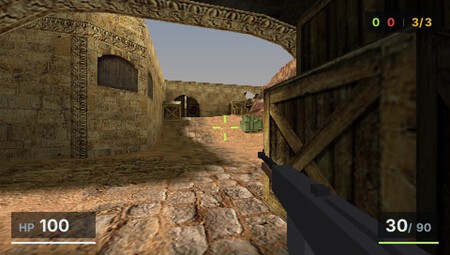
The initiative to bring Counter-Strike closer to the PSP is called OpenStrike. Visible on-screen, this project resembles the original game but operates on an entirely different undercurrent. What we see isn’t Valve’s commercial title running on the PSP but rather a new implementation that resurrects maps, rounds, and shooting sequences against bots. Users are tasked with providing maps and textures from their personal copies, while movement, rules, and rendering are governed by a structure specifically crafted for this project.
The Visionary Behind the Project
The mastermind behind this new undertaking is Yifeng Wang, known in the GitHub community as doodlewind. His work in open-source software and web technologies led him to explore the capabilities of PocketJS and Pocket3D. When presenting OpenStrike, Wang elaborated on selecting the PSP for its hardware limitations, viewing them as an opportunity rather than a setback. If the project could succeed on a platform with restricted resources, it would serve as a potent demonstration of what could be achieved.
Technical Hurdles and Solutions
Emulating a game designed for a PC on a platform like the PSP posed several challenges. The PSP operates on a MIPS architecture, distinctly different from that of PCs. Essentially, copying the executable to a memory card would be analogous to handing over instructions meant for a completely different machine. Wang needed to either recompile the code, emulate its environment, or, more innovatively, build a new implementation that spoke the PSP’s unique language from the ground up.
Once the architectural issues were sorted, a more substantial challenge loomed: optimizing performance to fit the PSP’s constraints. The PSP-1000 offered only 32 MB of memory, available for use is about 24 MB, and boasted a 333 MHz processor. All components essential for game functionality had to coexist within these limits. Achieving a smooth 60 frames per second required a rigorous workload, allowing no room for inefficiencies.
Optimizing Performance for the PSP
To address these limitations, OpenStrike prepares as much data in advance as possible. It smartly incorporates map lighting into geometry, adapts graphical resources for the console, and uses pre-calculated visibility data to limit rendering to only those areas visible to players. Benchmarks from a physical PSP indicated that gameplay on dust2 maintains an impressive 60 FPS, even amidst combat. However, it’s important to note that this remains a proof of concept, devoid of multiplayer functionality, shopping mechanics, or the full spectrum of the original game’s systems.
A Step Towards the Future
As evidenced by the demo released by Wang, the convergence of Counter-Strike and the PSP has transitioned from mere speculation to reality. While OpenStrike may still lack the full capabilities of the original game, it succeeds in capturing the essence of that gaming experience. This project is not merely about revealing hidden power within the PSP; it signifies that even constraints can pave the way to innovation.
Images | Yifeng Wang