
We’ve been talking about smart glasses for years, but the big obstacle has always been the same: the screen is still too big to go unnoticed. At the University of Würzburg , a group of physicists assures having manufactured the “ smallest light-emitting pixel in the world ,” a light point that measures about 300 by 300 nanometers and that, even with that size, reaches, according to the team, the brightness of a conventional 5 by 5 micrometer OLED pixel . If the technology can scale, a complete microdisplay could be practically integrated into the frame of glasses, invisible to the naked eye.
The advance comes from Germany, where a team led by physicists Bert Hecht and Jens Pflaum has managed to reduce OLED technology to a scale never before achieved. Your work was published on October 22, 2025 , in *Science Advances* and describes a method for fabricating ultra-compact light-emitting pixels using optical antennas. The goal is not just to demonstrate that they work, but to lay the foundation for a new generation of projection modules for smart glasses and other wearable devices .
A tiny pixel, big brightness. More than a question of size, the discovery lies in the luminous intensity that they have managed to maintain by miniaturizing the structure. The result points to very high resolutions in practically imperceptible spaces. In a device of this type, the panel is not seen from the front: it acts as a light source that projects the image onto the lens, which allows the projection system to be integrated into areas as discreet as the frame of glasses.
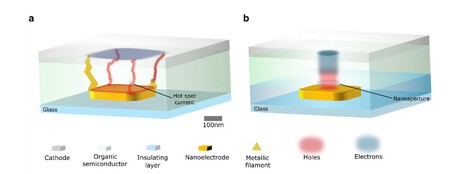
<span>Scheme of the nanopixel developed in Würzburg</span>High resolution in no space. Reducing a light source to nanometric dimensions without losing power is not only a question of miniaturization but of materials engineering . The team has shown that it is possible to guide the current and optimize the emission in a structure where space barely allows room for error. With this control, OLED technology enters a new phase, in which pixels cease to be discrete elements and become optical components with antenna behavior.
To achieve this, the researchers had to completely redesign the way current flows within the pixel. In previous attempts, electricity was concentrated at the edges and ended up damaging the material, like lightning that always seeks the shortest path. Their solution was to add a thin insulating layer that blocks these leaks and leaves a tiny central opening through which the current passes in a controlled manner. This way they achieved a stable emission without the pixel being destroyed over time.
<img alt="After cell phones, cars, robots, and AI, comes China’s next great technological avalanche: glasses" width="375" height="142" src="https://i.blogs.es/7b1af8/inmo-go12/375_142.jpeg"/>Efficiency and color. Although the prototype demonstrates solid operating density and stability, its external quantum efficiency is as low as 1%. The researchers hope to improve that figure by optimizing organic materials and antenna architecture , and plan to expand the emission spectrum to all three primary colors. Only then could this technology be considered ready for the next generation of portable microdisplays .
Images | Xataka with Gemini 2.5 | Isis France
In Xataka | Xiaomi AI Glasses are much more than Ray-Ban Meta because they are not just a product. They are a platform.