

The Rise of America’s Transcontinental Train Network
The train system is often regarded as the backbone of modern transportation , facilitating movement and commerce across continents. In Europe , for instance, countries are intricately linked by expansive rail networks that allow seamless travel from one nation to the next. Similarly, Japan and China have made significant investments in high-speed rail, with China alone boasting nearly 50,000 kilometers of high-speed track. In stark contrast, the United States struggles with a lack of high-speed rail options and relies predominantly on automobiles and air travel for passenger transport. However, an ambitious project nicknamed the ‘Transcontinental Chief’ aims to transform the U.S. train landscape by connecting New York and California with an extensive rail network.
Understanding Amtrak
To understand the need for such a project, it is essential to look at the current state of train travel in the U.S. The national passenger train service, Amtrak , officially known as the National Railroad Passenger Corporation, operates over 500 stations across 46 states . Despite its extensive network covering around 39,000 kilometers , Amtrak transported only 32.4 million passengers in 2024 , with most routes running below 200 km/h . This is starkly lower compared to Renfe , the Spanish train operator, which transported 35.2 million passengers in high-speed services alone that same year.
Introducing the Transcontinental Chief
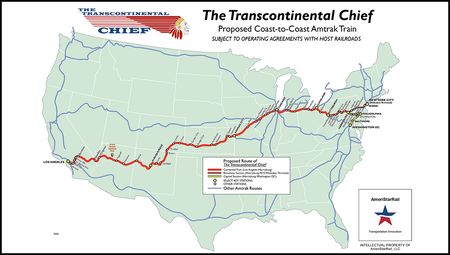
The ‘Transcontinental Chief’ is a proposal by a private company, Ameristarrail , that aims to create a high-capacity interurban rail service between New York and Los Angeles . This route will connect major cities including Philadelphia , Washington D.C. , Chicago , and Las Vegas , as well as iconic tourist destinations like the Grand Canyon . By linking these urban centers and attractions, the project hopes to enhance travel and boost tourism.
Strategies for Effectiveness
One of the standout elements of the Transcontinental Chief project is its focus on recycling infrastructure . Ameristarrail aims to maximize existing resources by utilizing already constructed tracks and stations, including those managed by Amtrak, to reduce costs and expedite the planning process. By leveraging existing infrastructure, the project aims to minimize the need for new legislation and public financing, streamlining the execution of the plan.
Furthermore, the Transcontinental Chief will also cater to unique needs in transportation . For instance, to attract families and business travelers who wish to bring their vehicles, Ameristarrail envisions a ferry-like service where private cars could be loaded onto the train. This feature allows passengers to travel cross-country while enjoying the comfort of their own vehicles at their destination.
Pioneering Innovations
To enhance logistics for truckers, the project will include cars capable of accommodating commercial vehicles and their drivers. This feature, termed the ‘Rolling Rest Stop’ , allows drivers to take mandatory breaks while efficiently transporting goods across the country without losing valuable travel time. Such innovations not only improve convenience for travelers but also provide a viable solution for the freight industry .

The Ameristarrail team is targeting a launch date of May 10, 2026 , coinciding with a significant event—the 250th anniversary of U.S. independence. While Amtrak has noted that they are not yet committed to the project due to uncertainty over public investment, many experts believe that there is substantial potential for a profitable passenger service, especially given the growing demand for intercity travel.
Ultimately, while the path ahead may be challenging, the Transcontinental Chief has the potential to reshape how Americans view train travel and the overall transportation landscape.