
The Rise of Agrovoltaics : Solar Panels and Farming Unite in Álava
The shared use of soil is a growing point of contention among farmers. Many are uneasy about the coexistence of solar panels and crops within their fields. However, emerging studies reveal that agrovoltaic systems might be one of the most effective solutions for the agricultural sector. Recently, in Álava , Spain, Iberdrola has begun an experiment involving apple trees intended for cider production, demonstrating a promising synergy between agriculture and renewable energy.
Iberdrola’s Bold New Venture
Iberdrola, in collaboration with the City of Vitoria-Gasteiz , has announced plans to construct a new agrovoltaic plant in Álava. This groundbreaking initiative will take place on land designated by the City Council as part of the “ Vitoria-Gasteiz: Laboratory City ” municipal program.
The agricultural management will be overseen by Kuartángo Sidrería, a leader in agricultural research in the province. Their objective is to enhance local apple production specifically for cider. Notably, this project is the only agrovoltaic endeavor selected within the Basque Country during the first round of calls for funding for innovative renewable energy and storage projects, featuring a 901 kW photovoltaic installation.
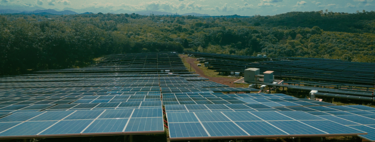
<img alt="The integration of agriculture and solar technology" width="375" height="142" src="https://i.blogs.es/7b949e/guia-de-imagenes-destacadas-1-/375_142.png"/>Harnessing Innovation: Panels and Apple Trees
The groundbreaking project aims to fulfill two essential goals: generating green energy while simultaneously enhancing agricultural productivity. Iberdrola notes that the solar panels will create shade over the apple trees, thereby reducing irradiation and thermal stress. This protection will not only augment crop yields but also contribute to improved soil quality and reduced water consumption.
Technological Advancements for Optimal Performance
The installation embodies multiple innovations designed to maximize both energy generation and crop growth. An artificial intelligence software, crafted by Basque company Powerful Tree, will monitor and adjust the orientation of the solar panels in real time to maximize their effectiveness. The solar modules will be mounted on a specialized structure 4.1 meters high, facilitating both tree growth and the movement of agricultural machinery. Additionally, a high-strength steel cable system will be incorporated to minimize maintenance costs.
The solar panels will each have an output of 700 W and are bifacial, meaning they can capture solar energy from both sides. This setup will be supported by three inverters totaling 750 kW , along with a 240 kW storage system that provides approximately two hours of autonomy.
Learning from Global Examples: The Italian Mirror
This initiative in Álava is not an isolated example. It parallels the efforts seen at the Bodega de la Volta in La Puglia, Italy, where 7,770 solar panels were installed across vineyards. Results from that project were remarkable: grape harvests were delayed by three to four weeks, which improved the quality of the grapes. Irrigation water consumption decreased by 20% , and the balance between acidity and alcohol content was achieved without artificial corrections. Additionally, the system alleviated plant water stress and allowed for the cultivation of uncommon grape varieties in the region.
Agrovoltaics Extends Beyond Crops
The concept of agrovoltaics extends beyond crop production; it also proves advantageous for livestock. For example, in New South Wales , Australia, research showed that sheep grazing under solar panels experienced improved wool quality. The reason? The shade provided by the solar modules allowed the animals to access more varied and fresher grass, simultaneously reducing maintenance costs by functioning as a “natural cover.”
A Broader Perspective: Many Examples, One Conclusion
From Puglia to Australia and now to Álava, agrovoltaics represents much more than merely a technological marvel: it symbolizes a new era of coexistence between the agricultural sector and the green transition. We are moving away from choosing land use for either solar energy or crop production; instead, a hybrid approach emerges whereby both can thrive in harmony. In the agricultural landscape of Spain, as we approach 2025, the worth of a hectare will increasingly be measured not only in kilos of crops but also in kilowatts generated. The apple trees in Álava, growing under solar panels, could soon become a beacon of this new ecological balance.
Image | Iberdrola and Unsplash
Xataka | Some researchers have uncovered which is the most suitable crop for agrovoltaic facilities: tomatoes .