
The Awakening of New Horizons
About 9.5 billion kilometers from Earth, a spacecraft built by humans over two decades ago continues its journey through a largely unexplored region of our Solar System. Launched in January 2006, New Horizons bypassed Pluto and entered a state of hibernation for 321 days, during which it silently traveled farther from us. Recently, this remarkable probe sent a signal confirming its awakening, indicating it was still in good health, but without delivering any visual treasures or groundbreaking discoveries.
An Autonomous Awakening
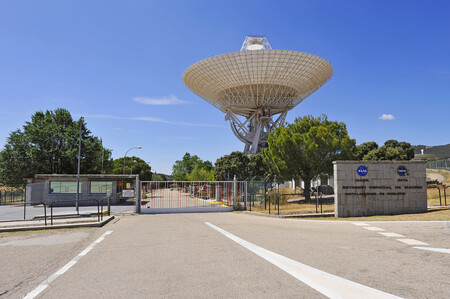
This awakening was not a response to an Earthly command but a carefully programmed sequence of instructions pre-loaded into its computer system before entering hibernation. New Horizons awoke on June 23, executing its internal protocols successfully without human intervention. It took nearly 8 hours and 52 minutes for the signal to reach the Deep Space Network station located near Madrid, confirming its operational status.
From the station near Madrid, confirmation was received that New Horizons had woken up and was still in good condition.
A Clever Approach to Hibernation
During its hibernation, New Horizons did not simply shut down. A significant portion of its systems remained inactive to conserve energy and minimize wear. Nevertheless, the flight computer consistently monitored its status and sent out a beacon once a week to assure that everything was functioning as it should. This innovative method allowed the team to maintain a connection with the probe without overwhelming the communication channels.
A Robust System for Extreme Conditions
New Horizons operates using a 12MHz Mongoose V processor, a remarkable piece of technology designed to withstand the harsh conditions of space travel. It distributes commands among the device’s subsystems and initiates recovery actions if necessary. This level of autonomy is essential; at such vast distances, immediate human intervention is impossible.
Storing Data for the Journey Home
Following its observations, New Horizons stores data on two 8 GB solid-state drives for future transmission. The minimal storage capacity emphasizes the need for efficient data management. The team must prioritize which information to send back to Earth while waiting for optimal communication alignment.
Innovative Energy Solutions
As the probe journeys further from the Sun, it relies on a radioisotope thermoelectric generator, not solar panels, to harness energy from the decay of plutonium-238. This energy source diminishes over time, meaning each instrument’s activation requires careful consideration.
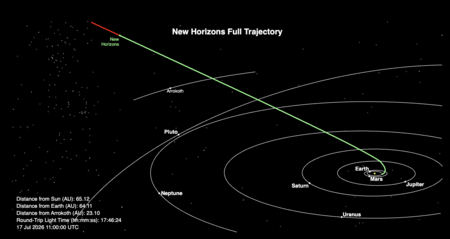
After visiting Pluto and Arrokoth, New Horizons continues to move outward from the Solar System.
The Challenges of Finding Earth
Communicating from the outer reaches of our Solar System involves intricate navigational tasks. The spacecraft uses onboard star catalogs to ascertain its orientation and align its antenna correctly with Earth. This involves adjusting the whole probe’s position as the antenna cannot move independently.
Continued Scientific Observations
Remarkably, even while in hibernation, New Horizons continued its scientific mission. Instruments like SWAP, PEPSSI, and Venetia Burney maintained their observational duties, collecting data on surrounding particles, plasma, and dust. This dual capability is a testament to the probe’s resilience and scientific purpose, enhancing our understanding of the cosmos, even in its deepest slumbers.
A spacecraft from two decades ago does not age like our everyday technology. Despite the insurmountable distances and challenges, New Horizons exemplifies relentless ingenuity and the spirit of human exploration—a true pioneer in the vast ocean of space.