
The Innovative Mars Exploration Robot: A Ball Bug Stuffed with Dandelion Drones
For over 30 years, humanity has relied on rovers to explore the surface of Mars. Despite significant advancements in our understanding of the Red Planet, many regions, particularly its extensive tunnel systems, remain largely unexplored. Recently, a team from the New Mexico Institute of Mining and Technology has proposed a groundbreaking solution: sending a ball bug robot filled with dandelion drones into these subterranean passages. While unconventional, this approach leverages insights from nature to address significant exploration challenges.
Biomimetics: Nature’s Ingenious Solution
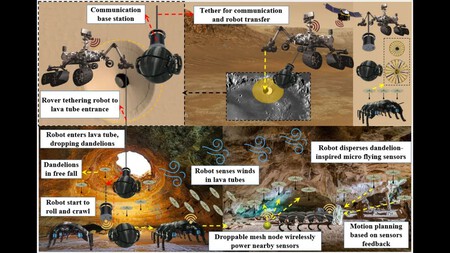
Professor Mostafa Hassanalian and his team have taken an innovative approach by employing biomimetics—technology inspired by the natural world. Their research aims to design two distinct types of drones: one mimicking scale insects and the other inspired by the dispersal mechanisms of dandelion seeds. The primary robot, resembling a mealybug, can protect its internal components by retracting into a ball, creating a safe enclosure for the smaller drones that can be released once inside the tunnel.
The Challenges of Martian Tunnels
Mars is home to a complex web of volcanic tunnels, some stretching as far as 1,200 kilometers and featuring lava tubes that exceed 250 meters in diameter. Current rovers, such as Curiosity and Perseverance, are ill-equipped to venture into these vast structures. Without the ability to collect data from within, crucial insights remain inaccessible until human exploration occurs, possibly unveiling dangers lurking within. This highlights the urgent need for remote sensing and exploration tools tailored for these challenging environments.
A Clever Robotic Solution
Hassanalian’s team proposes a two-part robotic system. The initial component is a robust, spherical robot that can penetrate the tunnels through drilled openings. Once inside, it unfurls, releasing numerous lightweight drones designed for long-distance travel, effectively leveraging airborne currents to explore and gather data over large areas.
Overcoming Limitations
While promising, this inventive approach faces unique barriers. One major concern is determining whether sufficient wind will exist inside Martian tunnels to facilitate the drones’ movement. To address this, Hassanalian plans to equip the main robot with a fan, providing additional propulsion to the drones. Furthermore, the drilling process will help create airflow through the tunnels, enhancing the effectiveness of the airborne drones.
Another significant challenge lies in the lack of sunlight within the tunnels, rendering solar power ineffective. The team plans to utilize piezoelectricity—harnessing mechanical pressure to generate energy—to power the drones inside these dark environments, ensuring their continuous operation.
Data Collection and Mapping
Equipped with humidity and temperature sensors, these drones will facilitate an in-depth analysis of the internal conditions within the tunnels. They will gather crucial data and contribute to mapping the extensive Martian tunnel networks, sending real-time information back to researchers via radio signals. However, the project is still in its conceptual stages and requires further funding to bring these ingenious robotic units to fruition.
Conclusion: A New Era of Exploration
With the introduction of this unique exploration robot, researchers could finally delve into the undiscovered sections of Mars. Thanks to innovations inspired by Earth’s biodiversity, this visionary technology represents a significant leap toward understanding the mysteries of the Red Planet’s sub-surface. As we inch closer to realizing these robotic counterparts, the potential for groundbreaking discoveries continues to grow, illuminating the path for future human exploration.
Image Credit | Magnificent Dave Huth | New Mexico Tech.