
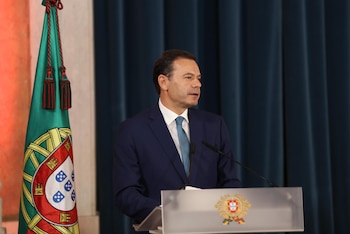
The Prime Minister of Portugal , Luís Montenegro , made headlines Thursday as he announced plans to initiate consultations regarding the recognition of Palestine as a state . This announcement comes in the wake of the upcoming United Nations General Assembly , scheduled for September , where this issue will be a central topic of discussion. Montenegro’s decision aligns Portugal with several other Western nations that are reconsidering their positions on Palestinian statehood.
Montenegro issued a statement on his office’s website, clarifying that the decision stems from discussions held during the recent UN conference focused on “the peaceful resolution of the Palestinian issue and the implementation of the two-state solution.” This conference was pivotal, as it underscored the international community’s growing momentum towards supporting Palestinian statehood . Notably, Spain and other countries have also urged for broader recognition and cooperation towards this objective.
“Through various discussions, we have learned that multiple states with which Portugal has engaged are willing to initiate procedures for the recognition of a Palestinian State. This readiness comes in light of assurances provided by the Palestinian Authority (PA) , the willingness from numerous Arab nations to recognize and normalize their relations with Israel , and concerning developments regarding the ongoing conflict,” Montenegro elaborated.
He emphasized the need for ongoing discussions and the involvement of countries that have had continuous dialogues with Portugal. Montenegro indicated that the conditions proposed by the Palestinian Authority must be deemed fulfilled based on the assurances presented at the conference. He highlighted the PA’s recent condemnations of terrorist acts carried out by the Islamic Resistance Movement, Hamas , and their pledge to work towards achieving a demilitarized Palestinian state overseen by international security forces.
Montenegro noted that the Palestinian leadership has committed to significant reforms, including internal elections, the disarmament of Hamas, and the restoration of full governance over the Gaza Strip post-Hamas withdrawal. Moreover, they have acknowledged Israel’s right to exist and have requested the necessary security guarantees to ensure peace. These steps signify a remarkable shift in the Palestinian leadership’s approach, which may bolster support for their statehood aspirations.
In response to Montenegro’s statement, Portugal’s President Marcelo Rebelo de Sousa lauded the government’s prudent handling of the Palestinian issue. He remarked that there is a unified foreign policy in Portugal, transcending the distinctions between governmental stances and public opinion. “The government has executed its duties with great prudence, ensuring that our actions resonate with those of the broader European context,” he asserted during a press briefing from the Azores .
As the situation evolves, it remains crucial for Portugal to navigate its decisions in correlation with international developments. Rebelo de Sousa emphasized that Portugal is carefully assessing the outbreak and escalation of tensions in the region, outlining a path forward depending on how circumstances unfold. He reiterated that there should be no divergences in foreign policy within Portugal’s governance framework, but rather a cohesive strategy that aligns all parties involved.
The announcement stirred a response primarily from left-leaning political factions within the National Assembly . The Communist Party of Portugal (PCP) has called for immediate recognition of the Palestinian state, citing the urgent need to address the ongoing humanitarian crisis. The Left Bloc (BE) followed suit, criticizing the government for being late in their support and suggesting possible sanctions against Israel to deter aggression.
In recent developments, several countries, including France, Canada, and Malta , have stated their intentions to formally recognize the State of Palestine at the upcoming General Assembly. British Prime Minister Keir Starmer has also expressed conditions under which the UK would consider recognizing Palestine, contingent upon Israel’s engagement in efforts to halt violence in Gaza.
The growing interest in Palestinian statehood highlights a significant geopolitical shift, with various nations reevaluating their strategies concerning the Israeli-Palestinian conflict. As countries prepare to make their positions clear at the upcoming UN session, the recognition of Palestine may soon see a pivotal turn.