

Many may not realize that writing machines played a significant role not just in the past, but they continue to influence our current world. In a pivotal moment in 1980, Apple made a decision that few understood at the time: it essentially declared war on the traditional writing machine. This dramatic shift can be traced back centuries, with its roots in ancient China where a revolutionary concept was first born.
However, there lies a mystery at the heart of this evolution—one particular machine, a prototype that changed the landscape of Chinese mechanized writing , remained lost for decades . Until recently, this enigma captured the imagination of historians and collectors alike.
Lost keys. The unfolding tale, as chronicled by The New York Times, traces its origins back to 2007 when Tom Mullaney, a Professor of Chinese History at Stanford , pondered the disappearance of Chinese characters. How could something so integral be entirely forgotten? This sparked a journey that sought to uncover the mechanization of a writing system as expansive as Chinese.
During his research, Mullaney discovered that while few, there had been numerous models of Chinese writing machines . Each model showcased ingenious ways to represent tens of thousands of ideograms within a compact frame.
One is missing. Driven by curiosity, Mullaney embarked on a global treasure hunt . He reached out to collectors, scoured ancestry sites, visited churches, museums, and even shops. As time went by, he amassed a unique collection of devices, each representing a crucial piece in the puzzle of mechanized writing history .
Nevertheless, there was one machine that evaded his grasp—the legendary Mingkwai.
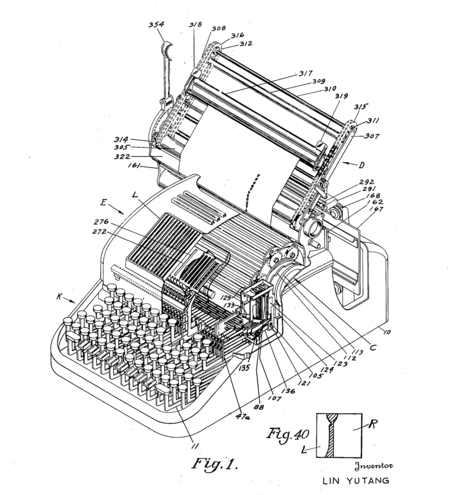
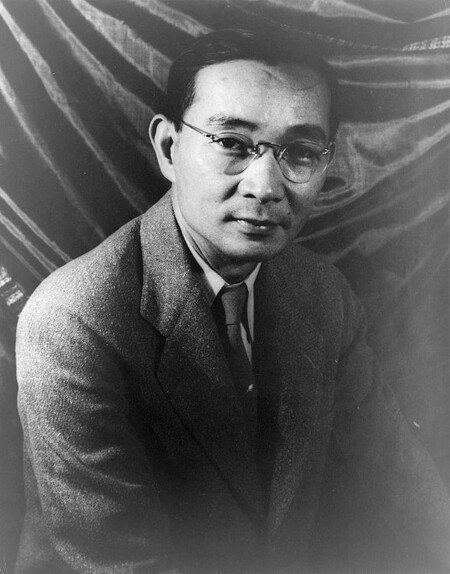
<span>Lin Yutang's Mingkwai writing machine, as illustrated in its patent application</span>The impossible machine. The Mingkwai was conceptualized in the 1940s by Lin Yutang, a Chinese intellectual residing in New York. Concerned that China would lag behind foreign powers without modernization, he sought to innovate writing technology. His groundbreaking design included a mechanical system where combinations of two keys would activate gears, revealing up to eight possible characters in a central display he dubbed “the magical eye .” This enabled users to select the correct character from multiple options.
Equipped with only 72 keys, Lin crafted an interface that could produce tens of thousands of characters —a versatile keyboard capable of expressing an expansive range of ideas. He named his invention Mingkwai, which translates as “clear and fast.”
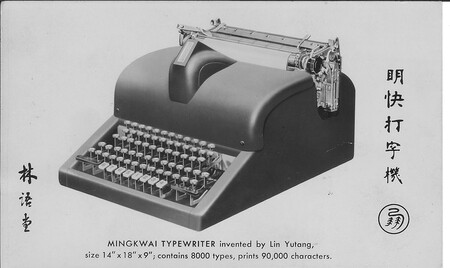
</div>Lost. Unfortunately, Lin’s presentation to executives at Remington was a disaster ; the machine malfunctioned, leading to his financial ruin . The only prototype created ended up sold to Mergenthaler Linotype , a Brooklyn-based printing company.
Subsequently, the trail of the Mingkwai was lost. In his book, The Chinese Typewriter (2017), Mullaney speculated that it likely ended up in a landfill.
But then, an extraordinary event took place.
<span>Lin Yutang</span>The reunion. In January 2025, Jennifer and Nelson Felix from Massapequa, New York, were rummaging through boxes after a family member’s death when they stumbled upon a wooden box containing an unusual typewriter with Chinese keys. Nelson, an avid Facebook seller, posted photos in a relevant group, setting off an avalanche of reactions .
Within an hour, hundreds of messages flooded in, many in Chinese, urging: “Contact Tom!” While giving a talk in Chicago, Mullaney received notifications that led him to recognize that this was indeed the Mingkwai .
Fear of losing it. Historians reported that Mullaney felt apprehension rather than jubilation upon hearing the news. If the machine were sold on eBay and transformed into a lamp or coffee table, it would vanish forever.
In a rush, Mullaney contacted the couple, explaining the machine’s historical significance and urging them to consider selling it to a museum. Jennifer soon grasped that this was no ordinary piece of junk ; it represented an object lost for half a century. “We didn’t want it to be lost again,” she told The New York Times.
From the basement to the campus. The story took a twist when Mullaney uncovered that Jennifer’s grandfather, Douglas Arthur Jung, had worked for Mergenthaler Linotype , possibly saving the machine from disposal. The family had unknowingly kept it safe for decades.
In April, the couple agreed to sell it to Stanford , which acquired it through a private donation. When it finally arrived in California, Mullaney anxiously supervised the unboxing. He discovered that the mechanism was even more delicate and sophisticated than he’d anticipated. This discovery raised intriguing questions about whether engineers could replicate Lin’s visionary design from 1947, which aimed to modernize Chinese communication.
<img alt="A huge secret factory is tilting the balance in the Ukraine War. Russia is multiplying a relentless army" width="375" height="142" src="https://i.blogs.es/15d5ce/ps---plantilla-portadas-xtk-456/375_142.jpeg"/>A recovered story. The saga of the Mingkwai transcends that of merely locating a rare machine. It serves as a metaphor for ideas that risk disappearing without a medium for expression. Mullaney understood he was possibly the last person capable of interpreting the significance of these machines: the linguistic challenges faced by a civilization, the technological aspirations of a marginalized nation, or the desperate elegance of a visionary inventor .
The Mingkwai was a device that went unappreciated in its time—too advanced yet cumbersome, a product of ideas far ahead of contemporary comprehension. Yet, through its recovery, Mullaney not only salvaged a museum artifact but also revived a vital chapter in the history of human writing evolution .
Image | Stanford Campbell, Brobough & Free, American Memory Digital Item Display
In an era where technology often outpaces our understanding, the story of the Mingkwai reminds us of the significance of preserving our past, especially in the realm of communication.