
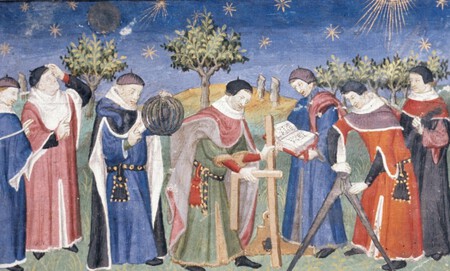
The Dark Ages Revisited
Historians have long struggled to reshape the negative perceptions surrounding the Middle Ages, often branded as a period of wars, famines, and ignorance. This era is frequently associated with barbarism and a regression in knowledge. However, a fascinating discovery about an 8th-century monk reveals a different narrative—one where intellect and ingenuity flourished.
The Remarkable Counting Technique
Imagine counting up to 9,999 using only your fingers. This astounding feat was not just an abstract idea but a practical skill employed long ago, particularly amongst scholars of the time. The art of counting on fingers, while seemingly rudimentary today, was crucial in an age devoid of calculators or even basic writing tools like paper and pen.
A Lost Art
Throughout history, people primarily relied on what was immediately available to them for arithmetic, leading to the rise of a unique method that allowed calculations using only their ten fingers. This intricate system reached a level of sophistication that is both astonishing and largely forgotten today. Evidence suggests that this counting technique dates back well before the Middle Ages, evolving through centuries of necessity.
The Venerable Bede: A Pioneer in Mathematics
One of the most significant figures in the history of finger counting is the Benedictine monk known as Bede Venerabilis, or Saint Bede the Venerable. Living between the 7th and 8th centuries in what is now the UK, Bede authored De temporum ratione (The Calculation of Time) in 725. This treatise not only focused on calendars and astronomical concepts but also introduced a system for counting numerically using fingers.
Counting with Precision
Bede emphasized the practical understanding of how to shape numbers using fingers. Starting with the basics, he described how to represent numbers from 1 to 9,999 using simple movements and positions of fingers. His groundbreaking insights into finger counting also laid the groundwork for similar techniques long after his time.
Understanding the Technique
So, how does one count with their fingers to understand numbers up to 9,999? The technique involves assigning different values to each hand and groups of fingers. The left hand represents units, tens, and hundreds, while the right hand corresponds to thousands and tens of thousands.
A Methodical Approach
Bede meticulously outlined how to bend specific fingers to indicate numbers, firmly establishing a way to convey numerical values effectively. This innovative system allowed individuals to perform calculations discreetly, especially in markets and crowded environments, playing a crucial role in commerce and communication.
Beyond the Middle Ages
Surprisingly, the counting techniques predating Bede’s work were also popular throughout the Roman era and into the later Middle Ages. Scholars like Jacob Leupold and Luca Pacioli later referenced this method, demonstrating its enduring relevance in the evolution of mathematics.
A Code for Communication
Not only was the finger counting system a practical tool for calculations, but it also served as a form of sign language. It allowed monks and merchants to communicate effectively without speaking, which was particularly useful in noisy surroundings or during religious ceremonies that demanded silence.
Conclusion: Shining a Light on the Past
The seemingly dark narrative of the Middle Ages is illuminated by these remarkable advancements in numerical representation. Far from being a time of ignorance, this period showcased human ingenuity and the evolution of communication and mathematics. As we delve deeper into history, the Middle Ages reveal themselves as a time of untold stories, complex systems, and skills that paved the way for future generations.