
Spain’s Water Reserves: A Precarious Balance Amidst Drought Fears
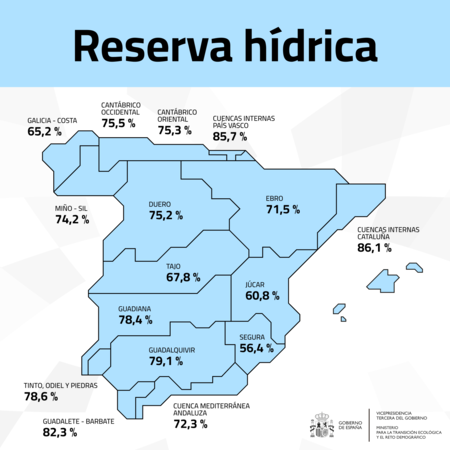
Spain’s reservoirs currently stand at 73.4% of their capacity, translating to approximately 41,100 cubic hectometers (hm³). While this figure is nearly 3,000 hm³ more than last year, it’s crucial to acknowledge that the nation is still haunted by the looming specter of drought. The situation is not as secure as it may seem, as water reserves have been diminishing over the past months, prompting alarm bells from environmentalists and officials who stress that droughts should be addressed with reservoirs full.
The Declining Trend of Water Reserves
The alarming reality is that water reserves have been on a downward trajectory since May, marked by a notably low level of rainfall in many areas. For example, Galicia has recently entered a pre-alert status for moderate water shortages, highlighting the urgency of the matter.
A detailed breakdown shows varying water levels across Spain. The Júcar basin holds only 60.8% of its capacity, while regions like the Basque Country and Catalonia boast figures exceeding 85%. The Atlantic region’s average stands at 74.8%, contrasting sharply with the Mediterranean side, which hovers around 68.8%.
A Comparative Analysis: Past and Present
When contrasting the current statistics with those of previous years, the outlook appears somewhat optimistic. At the end of July 2025, the reservoirs were at 68.4% with serious concerns about water scarcity in certain areas. For instance, the Segura basin recorded reserves below 29%, while today it exceeds 56%. Yet, the ongoing reduction in water reserves raises troubling questions.
The Persistence of Drought Conditions
Though current water levels may not be catastrophic, the recently observed decline in reserves cannot be ignored. Since reaching a high of 84.2% on May 19, reserves steadily fell to 73.4% by late July. This downward trend raises concerns about the long-term sustainability of water resources in Spain.
The Meteorological Context
This year’s meteorological conditions have been contradictory. A remarkably rainy winter provided a temporary boost to reservoir levels, making it one of the wettest on record. However, the transition to a particularly dry spring and June, which saw only 39% of normal rainfall levels, has reversed the previous gains significantly.
Strategizing for the Future
Experts argue it’s time to strategize for potential droughts when water levels are higher, not after the fact. Jorge Rodríguez-Chueca, a professor at the Polytechnic University of Madrid, notes that while current levels appear adequate, proactive planning and public awareness should be prioritized.
Moreover, the average annual water consumption in Spain is around 32,000 hm³. High consumption combined with lower rainfall could quickly escalate the risk of drought, making careful monitoring of water resources imperative.
Conclusion
Despite the relatively stable reservoir levels, the gradual decline over recent months serves as a stark reminder that the threat of drought is very much alive in Spain. The time to act is now; proactive measures should be undertaken to safeguard against future water shortages.
Continue to monitor updates from reliable sources like the Ministry for the Ecological Transition and local authorities to stay informed about water management strategies and potential shortages in the coming months.